
Matthew Hale Baxter, 47, was a part-time officer of the Pensacola Police Department in Pensacola, Florida — a department he first joined full-time in 2001, left in 2005 for other law-enforcement work, and rejoined part-time in 2018. In October 2026 the Florida Department of Law Enforcement arrested him twice in fourteen days.
The first arrest, on October 12, 2026, took him in his uniform, out of his own marked cruiser, at an alleged hydrocodone dead drop on his way home from a security shift at the airport (§01). On October 13, PPD said it was moving to terminate him; he was a former officer by the second arrest. The second, on October 26, 2026, came out of the electronic devices seized in the first case: forty announced charges — child sexual abuse material, sexual activity with animals, and photographs taken of strangers in restrooms (§02).
The posture of this file is printed here, once: charged, not convicted. Both cases are pending; the charges are accusations; and FDLE states the investigation remains active, with additional charges pending. Nothing in this file prints a disposition, because the record pulled contains none.
One limit prints with the spine. The children depicted in the material agents describe are identified by role only — never named, never described beyond the arrest report’s own words, never pictured. The people photographed in restrooms are unknown adults, and they are role-only here as well. That rule has no exceptions.
FDLE’s Pensacola agents received a confidential source’s information in the week before the arrest: a part-time Pensacola officer was buying prescription opioids without a prescription, and had been doing it for years. On Monday, October 12, 2026, agents watched the buy happen.
Baxter was working a security shift at Pensacola International Airport that day. At about 4:30 in the afternoon he left the shift and drove — in his department-issued uniform, in his department-issued cruiser — to 2111 North S Street, where a dealer’s payment-and-pickup arrangement, a “dead drop,” was waiting. Agents say they watched him park in the driveway and take a paper bag. When they arrested him, the FDLE narrative in the arrest record describes a pill container in one pocket holding eight 7.5-milligram hydrocodone pills and a second container in another pocket holding thirteen more.
The announced charges: two counts of possession of a controlled substance without a prescription and one count of unlawful use of a two-way communication device — each a third-degree felony. He was released on a $15,000 bond. The next day, October 13, the Pensacola Police Department said it was moving to terminate him; he was a former officer by the second arrest, and the precise effective date of the separation is not in the record pulled.
What he told the agents afterward is part of the arrest record, and it prints here as exactly that — his statement to FDLE, as the Pensacola News Journal reported it on October 18: that he had been purchasing 50 to 60 pills every week from a source known as “Q” for approximately the last ten years; that he paid $15 to $22 per pill; that he took between 20 and 30 pills a day; and that he also held a legal prescription for 60 pills a month. A statement to investigators is evidence the State will use. It is not a conviction, and this file does not print it as one.
His arraignment in the drug case was scheduled for October 30, 2026. What happened at it — his plea, the case number, the court’s next dates — lives in the Escambia County Clerk’s docket, and pulling it is this file’s first open item (22-01).
The drug case gave FDLE Baxter’s electronic devices. The first forensic pass over them ended his freedom a second time.
On Monday, October 26, 2026, FDLE agents — assisted by the Florida Office of Agricultural Law Enforcement and the United States Marshals Service — arrested Baxter again and took him to the Escambia County Jail. FDLE announced forty charges in the new case:
Four counts of possession of child sexual abuse material. Thirty counts of sexual activity involving animals. Four counts of digital voyeurism. Two counts of using a two-way communication device to facilitate a felony.
What the arrest report says the devices held, as the Pensacola News Journal reported it on October 28: more than 1,800 files that “met the statutory definition of bestiality,” found alongside four files of child sexual abuse material and four photographs Baxter is accused of taking himself: two adult men, nude from the waist down, photographed from underneath a restroom stall wall, unaware. An FDLE spokesperson told the News Journal that after forensic review, all of the voyeurism photographs were taken in a public restroom, and none in a school bathroom — a question that had to be asked, because of where Baxter had worked (§03).
The report also carries an allegation and an answer, and this file prints them together or not at all: agents say it is possible Baxter paid for child sexual abuse material through his Cash App account; Baxter denied ever paying for it, and said the account’s suspicious-activity flag concerned money he was sending to children he was helping financially support. Both statements are the arrest documents’. Neither is a finding.
On bond, the record carries two numbers, and this file prints both with their sources rather than blend them, because they measure different things. The Escambia County jail record (booking ECC26JBN013129) shows Baxter booked on October 26 and released the same day, with the grouped bond rows on that booking totaling $300,000. NorthEscambia reported on October 30 that clerk entries showed $145,000 posted for his release. The bond orders and the release ledger that reconcile the two figures are an open pull (22-02). The jail record also lists a circuit-court setting for November 20, 2026, at 8:30 a.m., as displayed at this file’s November 16 check.
Between the two arrests, the announced charges stand at forty-three: the forty of October 26, and the three of October 12. Those are arrest counts, printed as announced; the counts in any filed information await the clerk’s papers (22-01). FDLE’s word on where the case goes from here, in its October 26 release and repeated without decoration: “The investigation remains active, with additional charges pending.”
A part-time officer’s work at PPD was security work, and Baxter’s shifts put him where children are. Chief Winstrom told the News Journal that Baxter worked at every school inside the Pensacola city limit, and that many of his school shifts were at A.K. Suter Elementary School — security for its staff and students. He also worked church security, at Echo Life Church among the churches that hired the department — in the chief’s words, “maybe every church in the city limit that hired us for security.”
Against that exposure, the record pulled carries three statements, each printed as the statement of the body that made it. The Escambia County School District: there is currently no indication that any of the images involved students at the school. An FDLE spokesperson: after forensic review, all of the restroom photographs were taken in a public restroom — none in a school bathroom. And Echo Life Church, in its message to its congregation: authorities assured the church that none of the allegations against Baxter involve church members, and Baxter’s security contract through PPD with the church had been terminated — the News Journal dates that termination October 4, eight days before the first arrest, and this file prints the date as the paper reported it.
Mayor D.C. Reeves, at the October 28 press conference, put his own stake on the record: his daughter was a student at Suter while Baxter worked there. “I’m the mayor, but I’m also a parent.”
What this section does not contain is any finding that a local child was harmed. FDLE and the chief state the evidence so far points the other way, and the investigation that could change that statement is still running. Both halves of that sentence stand.
The second scandal in this file is a paperwork scandal, and it is the one the chief chose to say out loud.
Baxter was hired full-time in 2001. A police officer’s hiring requires a polygraph; the News Journal’s October 28 reporting of the chief’s account puts the 2001 polygraph in his personnel file. Baxter left the department in 2005, worked for other law-enforcement agencies, and came back as a part-time officer in 2018. The 2018 rehire required a polygraph of its own — under the department’s rules as they stood in 2018, the chief said, Baxter should have received another one.
Its chart is missing. On October 28, Chief Winstrom told reporters that the physical polygraph chart from Baxter’s 2018 rehire was missing from his personnel file, and that he could not explain the gap. The people involved in Baxter’s hiring, he added, have most or all retired from the department. What the surviving record does not establish is whether the 2018 exam was performed and its chart lost, or never performed at all — and no record pulled for this file shows anyone marking the test complete or falsifying the file. At that briefing, the chief did not say that anyone had. This file prints the gap exactly as he announced it: a required test’s chart, missing, unexplained.
The chief’s answer was not limited to one file. He ordered PPD staff to review every officer’s personnel file — every background check, every hire — to establish whether Baxter’s gap is an anomaly or a pattern. Going forward, he said, new hires’ polygraphs must be peer-reviewed by more than one examiner. His word for what the case did to the department was the one this file borrows for its record: “broken trust.”
What the department-wide review finds — and whether the State’s certification body acts on any of it — is an open pull on this file’s face (22-03). A required polygraph whose chart cannot be found is a hole in the paper, and a hole is not proof of what passed through it. This file exists because of where that hole was found: in the folder of a man now facing forty-three announced charges.
This file prints its limits in the open, because on this record the limits are part of the story.
Charged is not convicted. Forty-three announced charges stand against Baxter across two arrests. Every one of them is an accusation the State has to prove. He has not been convicted of anything in any source pulled, no plea is on the record pulled, and the outcomes live where outcomes live — in the Escambia County Clerk’s dockets (22-01).
The reel’s one compression. The news report this file answers says the missing polygraph belonged to Baxter’s personnel file “from when he was hired more than 20 years ago.” The record refines it: the missing chart is the 2018 rehire test’s — the News Journal’s account of the chief’s refinement puts the 2001 hire’s test in the file (§04). The chief’s point survives the correction — a required test’s chart is missing from the file — but the file prints the correction, because the file is the record.
Two errors in the announcement as published. A published account of FDLE’s October 26 release — the spine of this case — misnames its own arrestee in its arrest line (“agents arrested Baker”) and states the case “will be prosecuted by the Office of the State Attorney, Second Judicial Circuit.” Escambia County sits in Florida’s First Judicial Circuit. The errors ride in the account as published; they are flagged here rather than silently corrected or silently repeated. FDLE’s original release is itself an open pull, and the prosecuting office of record is settled by the docket pull (22-01).
The two bond numbers. $300,000 is the total of the grouped bond rows on the October 26 jail booking; $145,000 is what NorthEscambia reported clerk entries showed posted for his release. The figures measure different things. This file prints both, attributed (§02), and does not average them into a number nobody stated (22-02).
“No local child was victimized” is, on this record, a statement by the investigating agencies about the evidence reviewed so far — printed as theirs, beside FDLE’s own notice that the investigation remains active. It is not this file’s finding, and the file does not upgrade it into one.
This file prints its open items in the open. Each pull below closes one, and the file will be updated at this same address when the paper lands.
The Escambia County Clerk of Court records for both cases: the case numbers, the operative filed informations, the October 30, 2026 drug-case arraignment outcome and plea, the second case’s arraignment and posture, all future dates — and the prosecuting circuit of record, against the “Second Judicial Circuit” line in the announcement as published (§05).
The bond orders and the release ledger behind the two figures the record carries: the $300,000 total of the grouped bond rows on the October 26 jail booking, and the $145,000 NorthEscambia reported the clerk’s entries showed posted for Baxter’s release (§02). The figures measure different things; the instruments settle how they fit.
The outcome of Chief Winstrom’s department-wide personnel-file audit — whether the 2018 polygraph gap stands alone or has company — and any certification action by Florida’s Criminal Justice Standards and Training Commission.
The FDLE-derived employment data (Florida person 156547, as reproduced in the National Police Index) names the middle years: the Escambia County Sheriff’s Office, June 13, 2005 through November 7, 2013, and the Florida Attorney General’s Medicaid Fraud Control Unit, November 8, 2013 through November 1, 2018, with an earlier Gulf Breeze Police Department entry overlapping his first Pensacola service. Those are entries in the published FDLE-derived data, printed at that grade; a certified FDLE ATMS employment history remains the closing record.
FDLE stated in its October 26, 2026 release that the investigation remains active with additional charges pending. The next filing — and any agency statement on victim identification — updates this file at this address.
Every file in the Public Court Records series, in one place. Counties: St. Joseph, Elkhart, Marshall, Allen, Marion, Hamilton, Hancock, Hendricks, Johnson and Sullivan in Indiana; Berrien, Cass and St. Joseph in Michigan; Middlesex in Massachusetts; Muscatine in Iowa; Will in Illinois; St. Tammany Parish in Louisiana; Sussex in New Jersey. Every file is free, forever.
Every material claim in this file traces to a record below. Reporting is credited to the outlet that did it. Where a source could not be reached in full, the file says so on its face. Last checked November 16, 2026.
The spine of the second arrest: the Florida Department of Law Enforcement’s October 26, 2026 release (posted 4:30 PM), as reproduced in the published account of it — Baxter, 47, of Pensacola, arrested on four counts of possession of child sexual abuse material, thirty counts of sexual activity involving animals, four counts of digital voyeurism, and two counts of using a two-way communication device to facilitate a felony; the arrest’s origin in the October controlled-substances case and the forensic analysis of the seized devices; the restroom image files; the assisting agencies; and the closing line this file repeats: the investigation remains active, with additional charges pending. The two errors in the account as published — the “Baker” misnomer in its arrest line and its “Second Judicial Circuit” prosecution line — are flagged at §05, not laundered; FDLE’s original release is itself an open pull. Named in: Intro, §02, §05.
The News Journal’s reporting from the FDLE arrest documents: the October 12 dead-drop arrest (2111 North S Street; the pills in two pocket containers — eight 7.5-milligram pills, and thirteen more; the confidential source) and Baxter’s post-arrest statement (50–60 pills a week from “Q” for about ten years; $15–$22 a pill; 20–30 a day; a legal 60-a-month prescription), October 18; and the second case’s arrest report (the 1,800-plus bestiality files; the four CSAM files; the four restroom photographs of two adult men; the FDLE spokesperson’s public-restroom confirmation; the Cash App allegation and Baxter’s denial; the missing 2018 polygraph chart in the chief’s own words), October 28. Named in: §01, §02, §03, §04.
The News Journal’s account of Mayor Reeves’s October 28 press conference: the department-wide personnel-file review, the “broken trust” statement, the peer-review change for future polygraphs, the school and church security history, and the mayor’s statement as a Suter parent. Named in: Intro, §03, §04.
The church’s statement to its congregation — the authorities’ assurance that no allegation involves church members — and the October 4 contract-termination date this file prints as reported. Named in: §03.
NorthEscambia’s report of the second case’s probable-cause record (the 40 counts itemized; the iPad files; the restroom photographs) and the bond comparison this file prints at §02: the jail booking’s grouped rows totaling $300,000 against NorthEscambia’s report that clerk entries showed $145,000 posted. NorthEscambia also published the lead photograph (see THE PHOTOGRAPH). Named in: §02, Lead.
Pensacola’s ABC affiliate: the drug charges and firing as announced October 13 (carried in The Florida Press’s October 14 account of WEAR’s reporting), and reporter Melanie Levy’s October 26 live report from police headquarters — the video of record below. Named in: §01, §05.
The 45-second reel this file answers — WEAR Channel 3 reporter Melanie Levy’s live report from Pensacola Police headquarters on the day of the second arrest, reposted to her Mel Levi page. Its news core — the second arrest, the charge families, the first arrest, the termination, the missing polygraph — checks against the FDLE release and the arrest reports at every point but the polygraph, whose compression into the 2001 hire is corrected at §05. It is a news report, and it is graded as one. Named in: §05.
The county’s public jail record for the second arrest: Matthew Hale Baxter, booking ECC26JBN013129 — booked October 26, 2026 and released the same day; four grouped charge rows (two-way communications device, § 934.215; digital/video voyeurism, § 810.145(2); prohibited image or video, § 828.126(6); prohibited depiction, § 827.071(5)) with bond amounts of $10,000, $40,000, $150,000 and $100,000, totaling $300,000; and a displayed circuit-court setting of November 20, 2026 at 8:30 a.m., as shown at this file’s November 16 check. The field the jail titles “Court Case Number” (PE200331) is not a Florida uniform case number and is not cited as one. Named in: §02.
The published FDLE-derived employment entries for Florida person 156547, Matthew H. Baxter, as reproduced by the National Police Index: Pensacola Police Department (full-time, from 2001; a return beginning December 17, 2018), the Escambia County Sheriff’s Office (June 13, 2005 – November 7, 2013), the Florida Attorney General’s Medicaid Fraud Control Unit (November 8, 2013 – November 1, 2018), and an earlier Gulf Breeze Police Department entry. Printed at the archived-record grade; a certified FDLE ATMS history is the closing record (22-04). Named in: §06.
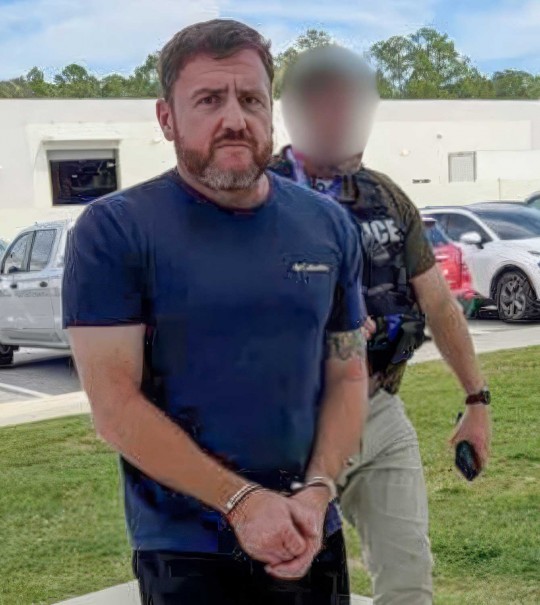
The lead image is the photograph NorthEscambia published with its October 30, 2026 report: Baxter in a dark T-shirt, handcuffed in front, standing outdoors with a person in a police vest behind him — an arrest-scene photograph, not a department portrait and not a booking headshot (JPEG 540×605, SHA-256 f4b8ae0e66e7c765b2ad230f836f688b846d0c2c76b62c75db6880531207fec7, byte-verified against the published carrier). The article carries no photographer caption; the image’s creator and reuse terms are not established on the record pulled, and its provenance and identity check are set out in this file’s photo record. We have not obtained an Escambia County booking photograph of Baxter. Named in: Lead.
Officers write tickets for every one of these. This section keeps the same record on the officer in this file.
NONE DOCUMENTED YET. If you photograph or film this officer speeding with no lights on, driving with a light out, rolling through without a signal, parked across a sidewalk or a crosswalk, parked in a handicap space, or breaking any road law you would be ticketed for, send the photo or the video in. Date, time, and place required. Verified submissions run here, dated, with the picture or the footage itself.