Dennis Tyler served Muncie, Indiana for more than fifty years — forty-two of them as a city firefighter, then the Indiana House of Representatives, then two terms as the city’s 33rd mayor. On November 18, 2019, with six weeks left in his final term, FBI agents arrested him at his home. The charge was one count: theft of government funds, in United States v. Dennis Tyler, No. 1:19-cr-360 in the Southern District of Indiana.
The admitted conduct fits in one sentence. In December 2015, in a parking lot, the mayor of Muncie took $5,000 in cash from a city superintendent who was carrying it for a contractor — a thank-you for steering city demolition and excavation contracts to a company that was not the lowest or most qualified bidder. Tyler pleaded guilty under an agreement signed May 25, 2021, and on November 10, 2021 he entered his plea and was sentenced at the same hearing: one year and a day in federal prison, three years of supervised release, and $15,250 in restitution. He served the prison time at FCI Morgantown, West Virginia.
But the mayor was the hub of something larger. The Justice Department’s final accounting of the Muncie cases — six related prosecutions, nine people charged, eight convicted — describes a pay-to-play system the participants called “the Program”: $3,230,737 in public-works contracts steered to contractors who paid to be on the list, and approximately $1,568,324 lost by the City of Muncie and the Muncie Sanitary District. The man who decided which contractors were “greenlighted” held no public office at all.
This file is built from the paper: the Justice Department’s indictment, sentencing and closing releases in these cases, read in full; the plea agreement’s account as the hometown Star Press reported it from the document; the government’s sentencing memorandum as reported before the hearing; and the courtroom and custody reporting of the Associated Press, the Indianapolis Business Journal, IPM News and the Indiana Lawyer. Every claim stands at the grade its evidence earns, and §10 lists every pull that would raise a grade further — starting with the docket itself.
One rule governs the people in this file: eight of the nine were convicted, and their records print as convictions. The ninth — the man at the center of the machine — died charged, his agreement to plead guilty signed but his case never resolved and every charge dismissed, and he prints as exactly that.
The career, as the record carries it. Dennis Tyler was born in Muncie in December 1942, grew up on the city’s south side, and graduated from Muncie Central High School. He spent 42 years with the Muncie Fire Department, retiring as a line captain — the career he himself put before the sentencing judge, telling the court his actions had “left a stain” on it.
From the firehouse he went to the Statehouse: the Indiana House of Representatives, District 34, sworn in January 2006 and serving until December 2011, when he resigned the seat to take the mayor’s office. In November 2011 he defeated the incumbent mayor — Muncie’s first Democratic mayor in twenty years, the Ball State Daily News noted — and he has stated the start of the tenure in his own words, at his final State of the City address: “I took office on January 1, 2012 when I was sworn in.” He won a second term in 2015, running unopposed.
The Justice Department’s releases round the tenure loosely — “mayor from 2011 to 2019” in one, “elected in 2012” in another. The dates this file prints are the exact ones: elected 2011; in office January 1, 2012 through December 31, 2019 — eight years, the whole of them run while the contracts at the heart of this file were being let.
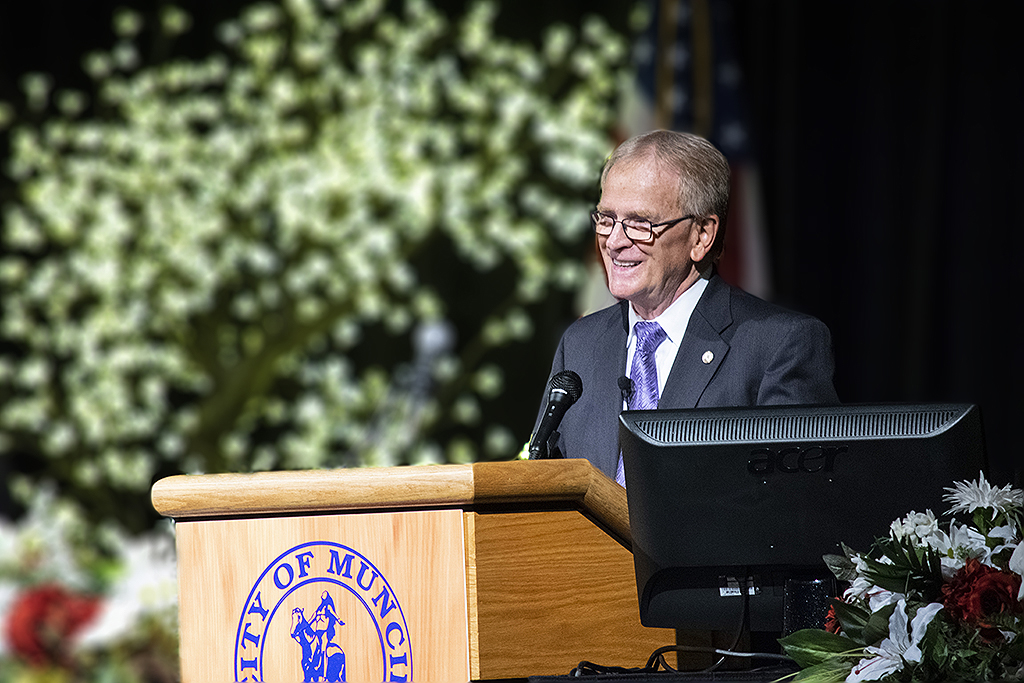
In January 2019 Tyler announced he would not run again. That April he gave his final State of the City address — the photograph at the top of this file is from that morning, April 16, 2019, the mayor at his own podium, seven months before the arrest — telling the room his community “has been a part of my life for 55 years.” At his sentencing he would frame it as “more than 50 years” in Muncie as “a firefighter, lawmaker and mayor” — and apologize to the citizens of the city for abusing their trust. Both things are in the record: the half-century of service, and what the last eight years of it became.
Between 2014 and 2019, the City of Muncie and the Muncie Sanitary District ran a series of public-works projects meant to benefit the city’s residents: the levee recertification program, which required the Sanitary District to acquire parcels near the White River, demolish what stood on them, and build levees and storage basins; the Walnut Commons project, an approximately $8.3 million housing development intended to house veterans who were experiencing homelessness; and blight removal for redevelopment, including the Kitselman Pure Energy Park brownfield on the city’s east side. By law, the work was to be bid competitively, so the city hired the most qualified contractors at the lowest cost. That is not what happened.
What happened, in the Justice Department’s words at the close of the cases, is that Mayor Dennis Tyler, Building Commissioner Craig Nichols, Sanitary District superintendent Tracy Barton and Sanitary District administrator Debra Nicole Grigsby — “under the corrupt influence of charged, but now deceased, Phil Nichols” — engaged in bid-rigging and kickback schemes, steering work to contractors who would “pay-to-play.” They also exploited Indiana’s Guaranteed Energy Savings Contract law to steer no-bid contracts to the same contractors.
Phil Nichols held no office. He was a former chairman of the Delaware County Democratic Party, a man regularly involved in raising money and advising candidates — and, by the admissions in his co-defendants’ own plea agreements, he held a powerful political control over Muncie officials. Contractors who wanted Sanitary District work had to be “greenlighted” by Phil Nichols. Greenlit contractors were the ones who had agreed to pay bribes or kickbacks to public officials, or to make contributions to certain political campaigns or parties. The conspirators had a name for the arrangement: “the Program.”
The arithmetic of the Program, from the Justice Department’s final release: officials awarded $3,230,737 in contracts to participating contractors, and the City of Muncie and the Muncie Sanitary District lost approximately $1,568,324. Contractors billed the taxpayers for work they did not do, or overbilled for work they did. And when the investigation closed in, some of the defendants — the Department’s account charges this to the group, and this file keeps it on the group — tampered with witnesses, retaliated against them, and destroyed evidence and altered documents in an unsuccessful attempt to keep the FBI from exposing the scheme.
U.S. Attorney Zachary A. Myers, at the end of it: “The citizens of Muncie placed their trust in a small group of government officials — many of whom were on a first-name basis with their constituents. This systemic public corruption not only resulted in more than $1.5 million of taxpayer money lost, but also caused immeasurable distrust in local government.”
The mayor’s own part of the machine was small, personal, and — by his plea — admitted. The factual basis of his plea agreement, as the Star Press reported it from the signed document, runs like this:
• Beginning in 2014, Tyler agreed to use his official position as mayor to steer demolition work on the Walnut Commons project to an unnamed local firm.
• The firm later withdrew from Walnut Commons. In October 2015, Tyler steered a contract for similar work on the Nebo Commons project to the same firm, even though it was “not the lowest responsive bidder.” The firm received $108,975 for the Nebo Commons work.
• On December 10, 2015, a person associated with that business gave Tracy Barton $5,000 in cash, which Barton delivered to Tyler “as a gratuity because Tyler had illegally steered contracts such as those related to the Walnut and Nebo Commons projects” to the company.
The Justice Department’s closing release of January 2023 dates the acceptance December 15, 2015 and ties the gratuity to Walnut Commons directly: Person A’s bid for the Walnut Commons job “was not the lowest, most qualified, responsive bid, but Mr. Tyler agreed to steer the contract to him as a favor. He later accepted the $5,000 payment as a thank you. The Walnut Commons contract was for $218,489.” The two documents date the handoff and the acceptance five days apart; this file prints both dates as the documents state them, and merges nothing.
The delivery itself is not in dispute anywhere: Tyler received the money in a parking lot from Barton, the Sanitary District’s Superintendent of Sewer Maintenance and Engineering, who carried the cash on behalf of the contractor. In the government’s documents the contractor is “Person A,” the owner of a Gaston excavation company; he was never charged in any account this file relies on, and he stays unnamed here, exactly as the record carries him.
Around that one envelope, the contracts kept moving. By the Justice Department’s sentencing account, the city and the Sanitary District awarded the excavation contractor hundreds of thousands of dollars in contracts in connection with kickbacks paid to Tyler and Barton, including Nebo Commons and the construction of a large sporting goods store; plea-day reporting put the firm’s improper city contracts at more than $250,000 for excavation and demolition work. Five thousand dollars was the price of the mayor’s favor. It was never the size of the work the favor moved.
The man who delivered the envelope became the government’s witness. Tracy Barton was indicted in the fall of 2018 — conspiracy to commit wire fraud, falsification of documents in a federal investigation, witness tampering — and afterward, in the words of the government’s sentencing memorandum, he “agreed to cooperate proactively and covertly” with the investigation and told authorities about the bribe payment he had delivered to the mayor. Then he called the mayor, and the FBI taped it.
What follows is the mayor’s own voice, as the government’s 48-page sentencing memorandum quotes the recording. The memorandum itself sits behind a pull listed at §10 — these quotes reach this file through the Star Press and IPM News, which reported the document before the sentencing hearing, and they are credited to it wherever they stand.
Barton told Tyler he believed the contractor who provided the bribe money had told investigators about the payment. The mayor professed to have little memory of receiving the money, or of helping the contractor: “I’m not saying I didn’t,” he said, adding that he would have “never remembered if you hadn’t brought it up to me.”
On where the money went: “My guess is that I probably used (the bribe money) to pay bills. And (when) somebody had a sewer bill that they needed (paid), I could give them the money. … I think that’s when I bought all them turkeys to give away and stuff. Which ain’t gonna mean a damn thing to (federal investigators).” He allowed that he was “sure I used some of the (bribe money) for my own personal stuff,” and that he would “go out and buy things and pay for people’s sewer bills and light bills and you’d be amazed.”
On the investigation itself, the mayor told Barton the federal authorities “wanted me and (Phil Nichols) more than anything.” And on the whole of the machine he had sat at the center of: “You know, I still don’t think we’re crooks. I don’t care what people say, I don’t feel that way. I think we’ve made mistakes.”
The prosecutors answered that sentence in the same memorandum: “Mr. Tyler’s belief that using some of the $5,000 to buy things for his constituents does not absolve him morally. Honest politicians don’t purchase clout with illegal proceeds.” And on the steering itself: “In doing so, Mr. Tyler chose to serve himself and the interests of insiders who were willing to buy their way into a rigged system.”
The investigation the government’s memorandum dates to 2014 — run by the FBI and the IRS, and styled Operation Public Trust in the Indiana Lawyer’s account — picked off the machine piece by piece before it ever reached the mayor. The building commissioner was indicted in February 2017. The superintendent who would carry the envelope, and a local businessman, followed in September 2018. A contractor was indicted in May 2019, and the district administrator and the levee contractor were joined in a case of their own that was on the books by the fall. (The grand jury was not finished with them: in March 2020 it indicted the party chairman and the police sergeant, and charged the administrator and the contractor anew.) By November 2019 the federal grand jury in Indianapolis had been charging Muncie for nearly three years.
On November 18, 2019, it reached the top. FBI agents arrested Mayor Dennis Tyler at his home that Monday morning; he had his initial appearance the same afternoon in the federal courthouse in Indianapolis, was released on conditions, and an automatic not-guilty plea was entered on his behalf. He was the seventh person indicted in the probe. U.S. Attorney Josh Minkler, announcing it: “Tyler not only betrayed the trust of his community, but violated federal law, and all in an effort to serve his own personal interests.”
The indictment — United States of America v. Dennis Tyler, No. 1:19-cr-360 — carried a single count of theft of government funds, exposing him to up to ten years in federal prison. As the U.S. Attorney stated it, the charge was accepting a $5,000 illegal cash payment after steering lucrative excavation work to a local contractor; the indictment’s own frame, as reported from the document, is that Tyler accepted the $5,000 from “Person A,” the owner of “Company A” of Gaston, in a course of conduct the government dated from 2014 to August 25, 2016.
And then the mayor went back to work. At his arraignment, the U.S. Attorney noted Tyler would be employed through December 31, 2019 — and he was. Dennis Tyler was never removed, never resigned, and never took a leave. He finished his second term as a man under federal indictment for selling the city’s contracts, and handed the office to his successor on schedule, on January 1, 2020. His trial was set, reset, and set again — the last date July 12, 2021. There was no trial.
On Tuesday, May 25, 2021, the plea agreement was signed — by Dennis Tyler, by his attorney James Voyles, and by Assistant U.S. Attorney Tiffany J. Preston, the prosecutor who had carried the Muncie cases from the first indictment forward. Tyler’s trial was seven weeks away. There would not be one.
The deal’s terms, as reported from the document the day it was signed: Tyler would plead guilty to the single count of theft of government funds — a count carrying up to ten years in prison and a maximum fine of $250,000. He would not be fined. He agreed to “pay restitution for all losses incurred by the defendant’s conduct.” He waived his right to appeal his sentence. And the agreement recorded, in the formula that matters at sentencing, that the former mayor had “demonstrated a recognition and affirmative acceptance of personal responsibility for (his) criminal conduct.” The length of the sentence was left open — the deal did not specify it. It would belong to Judge James R. Sweeney II.
The government’s side of the bargain surfaced in its sentencing memorandum: prosecutors had agreed to recommend a sentence at the lower end of the guideline range — twelve to eighteen months — but they asked the court, in terms, for “a term of imprisonment.” “His sentence must reflect the seriousness of his criminal acts, deter others in similar positions from abusing their positions of public trust, and promote respect for the law so as to restore faith in the local system of government,” they wrote.
One figure in the plea-day reporting never reconciled, and this file does not smooth it: the Indianapolis Business Journal’s account of the agreement said Tyler had admitted to receiving $5,238. The Justice Department’s releases — at the indictment, at the sentencing, and at the close of the cases — and the Star Press’s account of the same agreement all say $5,000, and $5,000 is what this file prints. The $5,238 itself is traceable in the companion Barton case: in the Star Press’s account of Barton’s signed plea agreement, the contractor withdrew $5,238 from the company’s bank account on December 10, 2015 and gave $5,000 of the cash to Barton for delivery to the mayor. But what Tyler’s own agreement admits is a question only that document settles, and the pull that closes it is listed at §10.
The agreement was signed in May. The plea itself was entered in open court on November 10, 2021 — at the same hearing where the sentence came down.
On November 10, 2021, in the federal courthouse in Indianapolis, Dennis Tyler stood before Judge James R. Sweeney II and did in one hearing what the case had been moving toward for two years: he pleaded guilty, and he was sentenced. The term: one year and a day in federal prison — the extra day is not a rounding; in the federal system it is what makes a prisoner eligible to earn good-time credit — followed by three years of supervised release, and $15,250 in restitution. The Justice Department’s sentencing release rounds the prison term to “1 year in prison”; its own closing table, and every courtroom account, carry the year and a day, and the year and a day is what this file prints.
The mayor spoke for himself. “I stand before you so ashamed, sorry and absolutely scared to death for what might happen next,” he told the judge, in the Star Press’s account of the hearing, carried on the Associated Press wire. He said his actions had “left a stain” on a career that included 42 years as a city firefighter, and he apologized to citizens, to his friends and to his family for abusing their trust.
At the hearing he also agreed to return the $5,000. In December 2021 the judge signed a $5,000 forfeiture order at the prosecutors’ request; the $15,250 restitution stood separately, and the Star Press noted it was not addressed in the forfeiture order. No source in the record names the restitution’s payee; the judgment that would name it is on the pull list at §10, and this file prints the figure without inventing its destination. The Star Press’s December account also records a further term the Justice Department’s releases do not carry: 100 hours of community service after his release — carried here at the paper’s word, with the judgment itself on the pull list at §10.
Acting U.S. Attorney John E. Childress, in the Justice Department’s release that day: “Mr. Tyler’s greed caught up with him and he will now be held accountable. The citizens of Muncie and the hard-working city employees deserved better out of their mayor.” FBI Special Agent in Charge Paul Keenan: Tyler “was entrusted by the community to represent their interests but instead chose to betray that trust through his abuse of public office for his personal gain.”
The sentencing record also carried conduct that was never charged, and this file prints it where it belongs — in the government’s sentencing account, labeled, not in the conviction. Per the Justice Department’s sentencing release, drawn from the court documents: in early 2015 a different city contractor performed tree removal at Tyler’s personal property, worth approximately $1,800, expecting it would keep him on the list of eligible bidders for city work. And when a separate contractor had been paid on invoices for work never performed, and the FBI came asking, Tyler asked two city employees to state they had requested quotes from that contractor — which was untrue. The employees refused. The sentencing memorandum put the same episode against the probe of Building Commissioner Craig Nichols: Tyler “knew that he was obstructing a federal investigation, and pressuring his subordinates to assist him in doing so”; “He literally asked his employees to lie on (Craig) Nichols’ behalf.” The memorandum also alleged that Tyler failed to properly document campaign contributions from a Kentucky insurance agent who had sold policies to the city and the Sanitary District, and that one $1,000 payment was deposited in his personal bank account. None of that was a count against him. It is in this file as what it is: the government’s account at sentencing, unanswered by any charge.
The sentence, served. Dennis Tyler began his term in December 2021 at the Federal Correctional Institution at Morgantown, West Virginia, a minimum-security prison; by December 30, 2021, the Bureau of Prisons’ own listings showed him there, as IPM News reported at the time. The man who had run Muncie for eight years spent that winter as a federal inmate in another state — and in a taped phone call already in the record, he had explained where some of the money that put him there went: sewer bills, light bills, turkeys for giveaways, and some of it, by his own admission, for his own personal stuff.
On Thursday, June 2, 2022, with more than six months of the term still to run, the Bureau of Prisons moved him out of Morgantown to community confinement overseen by the Bureau’s St. Louis Residential Reentry Management Office, as the Bureau told the Associated Press. His projected release from federal custody, as the Bureau stated it that June, was October 14, 2022. The Indiana Lawyer’s closing account of the cases confirms the sequence and the month — out of the prison in June, into a halfway house, and “released from federal custody in October” — and no source in hand names the actual day; the Bureau’s own record is on the pull at §10. The three years of supervised release imposed by the judgment ran from there.
That is where this file leaves his custody — stated exactly as the record leaves it. One widely copied biographical entry says he “was released from prison in April 2022”; April cannot be squared with a December start, five-plus months served, and the Bureau’s own reported dates, and it does not print here. What happened on the docket after sentencing — whether supervision ran its full course, was ended early, or was ever disturbed — is a docket question, and it stands on the pull list at §10 rather than as a guess in this section.
Nine people were charged in the Muncie prosecutions. Eight were convicted. Every disposition below is the Justice Department’s final accounting of the six related cases, released January 3, 2023, when the last sentence was imposed.
• Craig Nichols — Muncie Building Commissioner; the mayor’s appointee, Phil Nichols’ son. Indicted February 2017. He used false documents to steal $81,500 for demolition work his company never performed, and concealed his ownership of a second company that billed the city for asbestos work never performed, double-billed, or inflated; he admitted billing Muncie $454,400 in contracts for work not performed or fraudulently obtained, a $270,392 loss. Pleaded guilty to wire fraud and money laundering. Sentenced January 2019: 2 years in prison, 3 years of supervised release, $217,892 restitution.
• Tracy Barton — Superintendent of Sewer Maintenance and Engineering, Muncie Sanitary District; the middleman who carried the $5,000 to the mayor. Indicted September 2018, then cooperated covertly against Tyler. In his own case he admitted accepting bribes and kickbacks and taking part in steering $2,053,873 in contracts at Phil Nichols’ direction. Convicted of conspiracy to commit wire fraud: 1 year of probation.
• Debra Nicole Grigsby — District Administrator, Muncie Sanitary District, who approved contractor selections and signed the district’s contracts. She admitted taking kickbacks from Neal and Franklin for steering levee work to Franklin, and knowing her subordinate Barton was steering work and taking kickbacks too. Convicted of conspiracy to commit wire fraud: 1 year and a day, 2 years of supervised release, $370,556.99 restitution.
• Jess Neal — Sergeant, Muncie Police Department; owner of Red Carpet, Inc. and Express Properties, LLC. He admitted arranging for Franklin to pay kickbacks to Phil Nichols and Grigsby so Nichols would greenlight Franklin and Grigsby would steer Sanitary District levee work to him. Convicted of conspiracy to commit wire fraud: 2 years in prison, 2 years of supervised release, $55,650 restitution.
• Tony Franklin — owner, Franklin Building and Design, LLC. He admitted paying kickbacks to Phil Nichols and Grigsby in exchange for $1,170,667 in fraudulently steered contracts, on which the Sanitary District overpaid him more than $600,000. Pleaded guilty to conspiracy to commit wire fraud. Sentenced January 3, 2023 — the last sentence in the cases: 1 year and a day, 2 years of supervised release, $279,806.99 restitution.
• Jeff Burke — owner of Burke Rentals 1 and McGalliard Guns & More, the one private citizen on the board. Tipped by Sergeant Neal that the Sanitary District had to buy the Flea Market property to recertify the levee, he defrauded a bank for a quick loan, bought the property for $150,000 without disclosing its true value, and sold it to the City 41 days later for $395,000. Convicted of bank fraud — the Department’s own case summary adds making false statements to FBI agents, which its sentencing table omits; the count-by-count judgment is on the pull at §10: 6 months in prison and 6 months of home confinement, 2.5 years of supervised release, $245,000 restitution.
• Rodney Barber — owner, Barber Contracting, Inc. He admitted paying kickbacks to Phil Nichols and Barton for nearly $300,000 in levee-recertification projects. Convicted of conspiracy to commit wire fraud — the Department’s own case summary adds wire fraud and making false statements, which its sentencing table omits; the count-by-count judgment is on the pull at §10: 2 years of probation, $104,250 restitution.
And the ninth man — the one the whole board answered to. Phil Nichols, former chairman of the Delaware County Democratic Party, Craig Nichols’ father, held no public office and decided, by the admissions in his co-defendants’ pleas, which contractors were “greenlighted” into the Program. He was indicted in March 2020 on conspiracy to commit wire fraud, wire fraud and witness tampering. Before his case could be resolved, he entered into an agreement to plead guilty — his own plea agreement, the Justice Department records, admitted the conspiracy — and then he died. All charges against him were dismissed, as the law requires. He is the only person in this file who was never convicted, and this file prints him as exactly that: the charged center of the machine, whose admissions stand in his signed plea agreement — an agreement his death left unresolved, with every charge dismissed.
Whether Sergeant Jess Neal — a sworn Muncie police officer convicted of running kickbacks out of the same city hall — also gets a file of his own in this library is a separate question, and it is not this file’s to answer. His record stands here, complete, at the grade it earned: convicted.
What this file rests on, and what is still out. The conviction, the sentence and the dispositions of all nine defendants rest on the Justice Department’s own releases — the indictment release of November 18, 2019, the sentencing release of November 10, 2021, and the closing release of January 3, 2023 — each read in full for this build, and registered at Sources. The plea’s factual basis rests on the signed agreement’s account as the Star Press reported it from the document. The taped-call and sentencing-hearing material rests on the government’s sentencing memorandum and the courtroom reporting, each credited where it stands.
The pulls still open, in the order they would raise this file’s grades:
• The docket and the judgment, United States v. Tyler, No. 1:19-cr-360 (S.D. Ind.) — a PACER pull to confirm the full case-number suffix and the count’s statutory citation, to read the judgment itself (including the restitution’s named payee, which no release states), and to confirm what the docket shows after sentencing: no appeal (the plea waived it), and the course of the three-year supervised-release term. The ending printed here comes from the Justice Department’s releases and the courtroom reporting; the docket is the instrument that closes it.
• The companion judgments, United States v. Burke and United States v. Barber (S.D. Ind.) — the count-by-count dispositions that settle the one place the Justice Department’s closing release disagrees with itself: its sentencing table lists bank fraud alone for Burke and conspiracy to commit wire fraud alone for Barber, while its case summaries add making false statements to FBI agents for Burke, and wire fraud and making false statements for Barber. The flags at §09 point here.
• The government’s sentencing memorandum (48 pages, filed November 2, 2021) — the document the taped-call quotes in §04 are reported from. A copy is publicly hosted, but the host would not serve it to this desk; the memorandum is an attachment to the docket and rides with the PACER pull.
• The plea agreement itself — to close the one unreconciled figure in the plea-day reporting: the Indianapolis Business Journal’s account of the agreement put the admitted amount at $5,238; the Justice Department and the Star Press say $5,000. The document settles it.
• The Bureau of Prisons custody record — Tyler’s register entry, to carry the October 14, 2022 custody-out date at the Bureau’s own grade rather than as reported.
• The companion cases’ sentencing dates — the dispositions at §09 are the Justice Department’s final table; the individual sentencing dates of Tracy Barton and Debra Nicole Grigsby were not pinned for this build and are not printed.
• Phil Nichols — the record this build read states that he died before his case was resolved and prints no date; none is claimed here.
Nothing in this file waits on those pulls to stand. They are listed because the standard of this library is that a reader can see exactly where the paper runs out — and because the pulls are how the next update to this page gets written.
Every file in the Public Court Records series, in one place. Counties: St. Joseph, Elkhart, Marshall, Allen, Marion, Hamilton, Hancock, Hendricks, Johnson and Sullivan in Indiana; Berrien, Cass and St. Joseph in Michigan; Middlesex in Massachusetts; Muscatine in Iowa; Will in Illinois; St. Tammany Parish in Louisiana; Sussex in New Jersey. Every file is free, forever.
Every material claim in this file traces to a record below. Anything named in this file but not registered here stands in the file as reporting until the paper itself is in hand. Last checked November 11, 2026.
The closing release. U.S. Attorney’s Office, Southern District of Indiana, “Four Muncie Public Officials, a Former Police Officer, Two Contractors, and a Private Citizen Convicted and Sentenced for more than $3 Million in ‘Pay to Play’ Schemes,” January 3, 2023 — read in full. The final table of all eight convictions and sentences; the Program’s mechanics and totals ($3,230,737 steered; approximately $1,568,324 lost); the Tyler case summary (the $5,000 gratuity, December 15, 2015, the $218,489 Walnut Commons contract); the case summaries for Craig Nichols, Barton, Grigsby, Neal, Franklin, Burke and Barber; and Phil Nichols — his signed agreement to plead guilty, his death before his case was resolved, and the dismissal of all charges. Establishes §02, §03 in part, and §09. justice.gov
The sentencing release. U.S. Attorney’s Office, Southern District of Indiana, “Former Muncie Mayor Convicted and Sentenced on Corruption Charges,” November 10, 2021 — read in full. The sentence’s terms; the parking-lot delivery by Tracy Barton; the hundreds of thousands in contracts to the excavation contractor (Nebo Commons; the sporting-goods store); the tree-removal benefit (approximately $1,800, early 2015); the refused request that two city employees lie about quotes; and the Childress and Keenan statements. Establishes §03 and §07. justice.gov
The indictment release. U.S. Attorney’s Office, Southern District of Indiana, “Muncie Mayor Dennis Tyler Indicted on Corruption-Related Charge,” November 18, 2019 — read in full. The charge and its ten-year exposure; the arrest at his home and same-day initial appearance; the FBI/IRS investigation; and the related cases then on the books, with their case numbers (Craig Nichols, 17-CR-0021; Barton, 18-CR-284; Burke, 18-CR-285; Barber, 19-CR-190; Grigsby and Franklin, 19-CR-231). Establishes §05. justice.gov
The plea agreement, as reported from the document. The Star Press (Douglas Walker), “Former Muncie Mayor Dennis Tyler takes felony theft plea deal,” May 25, 2021 — the signing, the parties, and the factual basis: the 2014 steering agreement, the Walnut Commons withdrawal, the October 2015 Nebo Commons steering (“not the lowest responsive bidder”), the firm’s $108,975, and the December 10, 2015 cash handoff to Barton, delivered to Tyler as a gratuity. Establishes §03 and §06. Corroborated on the deal’s existence and terms by the Indianapolis Business Journal, May 25, 2021 — whose account carries the one unreconciled figure ($5,238) flagged at §06 and §10.
The Barton plea, as reported from the document. The Star Press (Douglas Walker), “Barton plea details alleged bribe to then-Muncie Mayor Dennis Tyler,” May 3, 2021 — Tracy Barton’s signed plea agreement: the contractor’s December 10, 2015 bank withdrawal of $5,238, the $5,000 handed to Barton for delivery to Tyler as a gratuity, and the parking-lot delivery. The origin of the figure flagged at §06. Establishes part of §03 and the trace at §06.
The sentencing memorandum, as reported. The Star Press (Douglas Walker), “Feds ask that Dennis Tyler be sent to prison,” November 3, 2021 (updated November 10, 2021) — a detailed account of the government’s 48-page memorandum: the taped Barton call and its quotes, the obstruction account, the tree at the Halteman Village home, the insurance-agent contributions allegation, the twelve-to-eighteen-month guideline range, and the government’s low-end recommendation. Establishes §04 and parts of §07. The memorandum itself is on the pull list at §10. IPM News’ sentencing report (Stephanie Wiechmann, November 10, 2021) corroborates the taped-call account, including the sewer-and-electric-bills line and “I still don’t think we’re crooks.”
The sentencing hearing. The Associated Press report of November 10, 2021 (via the Indianapolis Business Journal, the Indiana Lawyer and the Post-Tribune) — the sentence as imposed (one year and a day, three years of supervised release, $15,250 restitution), and Tyler’s statements to the court (“so ashamed, sorry and absolutely scared to death”; the “left a stain” line; 42 years as a firefighter), drawn from the Star Press’s hearing account. IPM News, November 10, 2021, corroborates the term and the guideline range. Establishes §07.
The forfeiture order. The Star Press (Douglas Walker), December 13, 2021 — Judge Sweeney’s $5,000 forfeiture order, Tyler’s agreement at the hearing to return the $5,000, and the restitution’s separation from that order; the same account records the 100 hours of community service ordered after his release, carried at §07 at the paper’s word. Establishes §07.
The custody. IPM News, December 30, 2021 — the Bureau of Prisons listing Tyler at FCI Morgantown. The Associated Press (via the Indianapolis Business Journal), June 8, 2022 — his June 2, 2022 release from FCI Morgantown to community confinement under the Bureau’s St. Louis Residential Reentry Management Office, and the projected October 14, 2022 release from federal custody. The Indiana Lawyer, January 4, 2023 — the closing confirmation (prison in June 2022, halfway house, out of custody in October) and Tony Franklin’s final sentencing. Establishes §08 and part of §09.
The indictment-day record. The Indiana Lawyer, “Mayor Tyler 7th Muncie individual to be criminally indicted,” November 18, 2019 — the case style and number (“United States of America v. Dennis Tyler, 1:19-cr-360”), the Person A / Company A frame and the 2014–August 25, 2016 window as reported from the indictment, the release on conditions, the not-guilty plea entered, the seventh-indictment count, and the arraignment note that he would be employed through December 31, 2019. Establishes §05.
The man. The Muncie Journal (Mike Rhodes), April 16, 2019 — Tyler’s final State of the City address, including his own statement of his January 1, 2012 swearing-in, and the photograph at the head of this file (see below). The Ball State Daily News’ mayoral retrospective — the 2011 defeat of the incumbent, the unopposed 2015 re-election, the first-Democratic-mayor-in-twenty-years line, and the succession by Dan Ridenour. Biographical particulars (born in Muncie in December 1942 — the exact day, December 4, rests on the encyclopedia record alone, and one biographical encyclopedia gives 1943; Muncie Central High School; the District 34 House service, January 2006 to December 2011; the fire-department captaincy) are carried in his published biographical record. Establishes §01.
The photograph. Muncie Journal, April 16, 2019 — Mayor Dennis Tyler delivering his final State of the City address at the Horizon Convention Center, Muncie; photograph by Mike Rhodes. It is a news photograph of the mayor in office, and it is captioned as one: no booking photograph of Tyler appears in any source consulted for this file. Identity verified against a second news photograph of the same man published by the Ball State Daily News (NewsLink Indiana) and against the same photographer’s April 2018 State of the City photograph. Provenance and verification are documented in this file’s build record.