Joseph Kenton “Kent” McGowen joined the Harris County Sheriff’s Department on October 4, 1990. In the early hours of August 25, 1992, he went to the home of Susan Diane White with two fellow deputies to serve a felony arrest warrant — a warrant he had personally sought. White refused to open the door. McGowen forced entry with his gun drawn and shot her dead in her own home.
Two Texas juries convicted him of murder for that shooting. The first conviction, in 1994, was reversed on trial-procedure grounds — never on innocence, and never on any finding that he was framed. The second jury convicted him on March 28, 2002 and assessed 20 years; the conviction was affirmed on June 5, 2003. He served 19 years, 4 months and 4 days and was released on July 14, 2021 because the sentence ended. No court has vacated the 2002 conviction. He has not been exonerated. The murder conviction stands today.
McGowen now runs a public campaign on the claim that he was set up — that a Harris County sergeant, John Denholm, framed him for a killing he says he did not commit. His November 15, 2026 reel drew some 130,000 views in two days. In it, he never names Susan White. He never says that anyone died. This file exists because the published court record — two appellate opinions and a federal one — says a great deal that his 62 seconds do not.
The posture of this file is printed here, once, and it governs every page that follows: both halves, or the file misleads. The convictions, the warrant testimony and the affirmance are printed at full strength, because they are the record. So are the two procedural reversals, the federal jury’s verdict against him and its vacatur, the forensic review he says his own lawyer never used, and a credentialed journalist’s published conclusion that he was wrongfully convicted — each carried at exactly the strength its source earns, and not one degree higher.
What follows is the account the published appellate opinion itself recites — McGowen v. State, No. 01-02-00416-CR (Tex. App.—Houston [1st Dist.] June 5, 2003), in its statement of the facts and the trial testimony.
The warrant. McGowen had actively sought the felony arrest warrant for retaliation against Susan White, and the trial testimony was that he had “manufactured many of the facts supporting probable cause in order to obtain the warrant” — telling the district attorney’s intake prosecutors, among other things, that White’s son headed a gang that was building and selling automatic weapons, that there had been prior reports of gunfire at her house, and that deputies had once taken a gun from her. The opinion records the sentence this file will not soften: “The prosecutor who approved the warrant testified that he would not have prepared the warrant had he known that appellant had manufactured these facts.”
Before that night. White had previously complained to McGowen’s supervisor that he was harassing her and her son, and that he had arrested the son because she had spurned his sexual advances. Those were her complaints, printed here as hers — allegations she made, carried in the opinion; McGowen disputes them, and his dispute is part of this file’s record (§04). Her son, a juvenile in the home that night, is identified in this file by role only, never by name.
The night. At about 12:30 a.m., McGowen arrived at White’s home with Deputies Malloy and Morong to execute the warrant. White recognized McGowen’s voice, refused to open the door unless he left, and called 9-1-1; on that call she said he had sexually harassed and threatened her. McGowen obtained his supervisor’s permission to force entry, went in first with his gun drawn, said “Put the gun down” three times, and fired three shots, killing her. A gun was retrieved from the bed beside her body — the opinion recites it, and this file prints it, because it is part of the record on which his self-defense claim was tried, and rejected, twice.
The first trial. A Harris County jury convicted McGowen of murder in 1994, and he was sentenced to 15 years. The Fourteenth Court of Appeals reversed on April 10, 1997 (McGowen v. State, 944 S.W.2d 481) — on trial-procedure grounds: the denial of an opening statement, hearsay rulings, a refused instruction. In the same opinion, the court overruled his challenge to the sufficiency of the evidence — that is, it held the evidence legally sufficient for a jury to reject his claim of self-defense. The Texas Court of Criminal Appeals vacated that reversal on October 28, 1998 and remanded; on February 3, 2000, the Fourteenth Court reversed again, on the opening-statement error. McGowen’s own Substack counts this history as his conviction being “overturned four times.” What no court in that history did — not once — was find him innocent, find the evidence wanting, or find that anyone had framed him.
The second trial. On March 28, 2002, in Cause No. 647,853 in the 232nd District Court, Harris County, a second jury convicted him of murder and assessed 20 years. On June 5, 2003, the First Court of Appeals affirmed the conviction across sixteen evidentiary issues. That affirmance is the last word any court has spoken on his guilt, and it has never been disturbed.
The review that changed nothing. In 2011–2012, the Harris County District Attorney’s Post Conviction Integrity Review Unit reviewed his case; at Assistant District Attorney Baldwin Chin’s request, McGowen wrote a statement for it. No exoneration resulted. He remained in prison for another decade, until the sentence itself ran out (§04).
Susan White’s family sued McGowen under 42 U.S.C. § 1983 — Harrison v. McGowen, 207 F.3d 226 (5th Cir. 2000). A federal jury found against him, and judgment was entered on January 31, 1997: $4,320,000 in compensatory damages and $1,000,000 in punitive damages.
On March 15, 2000, the Fifth Circuit vacated the judgment against him and dismissed Harris County from the case. The reason matters, and this file prints it exactly: the criminal conviction that had been given preclusive effect in the civil case had itself been reversed, so the judgment built on it could not stand. The vacatur was a consequence of the criminal appeals — not a finding that the shooting was justified, and not a finding that McGowen was framed.
What happened to the civil case after that remand is not established in any source pulled for this build. Whether it was retried, settled or dismissed is an open pull (26-01, §05). It is printed here as open. It will not be guessed at, in either direction.
The release. McGowen entered prison in 2002 under the 20-year sentence. He was released on July 14, 2021, after serving 19 years, 4 months and 4 days — his own count, printed on his fundraiser page. He was released because the sentence ended. He was not pardoned, not paroled into innocence, and not exonerated; the 2003 affirmance stood then and stands now.
The claim. In a running series of reels — October 27 and November 2, 2026, and the November 15, 2026 reel this file answers — McGowen says he was framed: that Sergeant John Denholm of the Harris County Sheriff’s Office was the “lead conspirator” in a setup, that two days after the shooting a corrupt major transferred Denholm into the Homicide Division for that purpose, that deputies who clashed with Denholm were bullied and destroyed, and that his own unnamed partner “did 17 years” at the same hands. His fundraiser — GiveSendGo campaign G31TC, “Please Help Exonerate an Innocent Officer” — sends donations to an unnamed attorney of record for an exoneration effort.
The grading, printed plainly. Every one of those claims rests on McGowen’s word alone. Denholm is verified as a real Harris County homicide sergeant of the era — the Houston Chronicle quoted him in that role in 1994 and as a homicide lieutenant in 2007 — but no charge, no discipline, no court finding and no independent source ties him to any setup, and the transfer story, the bullying account and the partner’s 17 years are corroborated by nothing in the record pulled. They are printed in this file as what they are: an interested party’s allegations, UNVERIFIED — his allegations, made by a man whose account of the central event has been rejected by two juries. This file opens no file on Denholm, and neither should anyone else, on this.
His side, at the strength it earns. Two things stand on his side of the record, and both are printed. First: journalist Jerry Langton investigated the case independently and concluded McGowen was wrongfully convicted — Reasonable Doubts: How Rumor and Innuendo Convicted Deputy Kent McGowen of Murder (2025). That is a credentialed journalist’s published conclusion, reached from his own investigation; it is reported here as exactly that. It is not a court ruling, and in the years since the convictions it has not moved any court. Second: McGowen holds a forensic review by consulting scientist Dr. Edward E. Hueske, prepared during his proceedings, which he says his trial attorney obtained but never used at trial — the attorney he names, paid some $300,000 by his family, per McGowen’s own November 15, 2026 Instagram post. That account is McGowen’s, printed as his; the review itself has not been produced to this desk (26-06, §05).
The omission. Across 62 seconds about being “sent to prison for something that I did not do,” the November 15 reel never says that anyone died. It never names Susan Diane White. It never mentions that the warrant he was serving was one he personally obtained — or that the prosecutor who approved it testified he would not have issued it had he known its facts were manufactured. It never mentions her harassment complaints or her 9-1-1 call, the two murder convictions, the procedural — not innocence — basis of the reversals, the 2003 affirmance, the federal jury’s $5.32 million verdict against him, the conviction-integrity review that left him in prison, or that he walked out because his time was done. A viewer would learn none of that from the video. Every item in this paragraph is from the published court record cited in this file’s sources — the same record any viewer can read.
This file prints its open items in the open. The spine above rests on the published appellate opinions; the pulls below replace summaries with the paper itself, and the file will be updated at this same address when the paper lands.
The disposition of Harrison v. McGowen after the Fifth Circuit’s March 15, 2000 vacatur and remand — retried, settled, or dismissed. Until the docket or the judgment is in hand, this file prints the civil case’s ending as open, and so should everyone.
Any habeas or post-conviction filing by McGowen after the June 5, 2003 affirmance — state (Tex. Code Crim. Proc. art. 11.07) or federal — and its disposition; and the identity and docket of the legal vehicle his current exoneration effort is actually running on, if one has been filed. A filed case is a public record; if it exists, it is the strongest document in this story.
The Harris County District Attorney’s Post Conviction Integrity Review Unit’s 2011–2012 review of this case — its closing disposition in the office’s own words, and McGowen’s written statement to ADA Baldwin Chin, to the extent the public record carries them.
Sergeant John Denholm’s Harris County Sheriff’s Office assignment history, from records — not from McGowen: whether and when he was transferred into the Homicide Division, and by whom. The transfer claim is the one checkable pillar of the setup allegation; it will be checked against paper or not printed as anything but an allegation. His current status is likewise a records question, not a rumor.
The identity and case of the partner McGowen says “did 17 years.” He has never named him — not in the reel, not in any source pulled. The two deputies with McGowen on the night of the shooting are named in the 2003 opinion; nothing in the record ties either of them to a 17-year sentence, and this file does not guess at a man’s identity from proximity.
Jerry Langton’s Reasonable Doubts (2025) read directly — its publication data and its documentary basis — rather than through podcast summaries; and Dr. Edward E. Hueske’s forensic review, if McGowen produces it. He says he holds tens of thousands of documents. Documents are what this file runs on; the door is open to paper, from anyone.
The Texas Public Information Act set drafted with this file: the Harris County Sheriff’s Office (the 1992 incident and internal records, the assignment records at 26-04), the Harris County District Attorney (the warrant file, the trial record, the integrity-unit review at 26-03), and the Harris County District Clerk (Cause No. 647,853, the whole of it). Drafted with this file; the set sends on the publisher’s word, and returns land here.
Every file in the Public Court Records series, in one place. Counties: St. Joseph, Elkhart, Marshall, Allen, Marion, Hamilton, Hancock, Hendricks, Johnson and Sullivan in Indiana; Berrien, Cass and St. Joseph in Michigan; Middlesex in Massachusetts; Muscatine in Iowa; Will in Illinois; St. Tammany Parish in Louisiana; Sussex in New Jersey. Every file is free, forever.
Every material claim in this file traces to a record below. The appellate opinions are the spine; everything else is credited to the source that did the work, at the strength that source earns. Where a source could not be reached in full, the file says so on its face. Last checked November 17, 2026.
The memorandum opinion affirming the 2002 murder conviction, read in full: the facts of the night of August 25, 1992, the trial testimony that McGowen manufactured many of the facts supporting the warrant against Susan White — and the approving prosecutor’s testimony that he would not have prepared the warrant had he known — White’s complaints and her 9-1-1 call, the retrial in Cause No. 647,853 (232nd District Court, Harris County), the March 28, 2002 conviction and 20-year sentence, and the June 5, 2003 affirmance. Named in: Intro, §01, §02.
The first reversal: the 1994 conviction undone on trial-procedure grounds — the denied opening statement, the hearsay rulings, the refused instruction — with McGowen’s sufficiency-of-the-evidence challenge overruled in the same opinion: the evidence was legally sufficient for a jury to reject self-defense. The reversal history it begins — the Court of Criminal Appeals’ vacatur of October 28, 1998 and the second reversal of February 3, 2000 — is carried in the Fifth Circuit’s account, below. Named in: §02.
The federal civil case: McGowen’s October 4, 1990 start at the Sheriff’s Department; the § 1983 jury’s award of $4,320,000 compensatory and $1,000,000 punitive damages (judgment entered January 31, 1997); and the March 15, 2000 vacatur of the judgment against him — because the criminal conviction given preclusive effect had itself been reversed — with Harris County dismissed. What the case did after that remand is not in this opinion and is printed in this file as open (26-01). Named in: Intro, §03.
Contemporary reporting of the March 2002 retrial and conviction, as preserved in republication; and the Chronicle’s own archive for the era’s other figure: Sergeant John Denholm quoted as a Sheriff’s homicide sergeant in November–December 1994 (the Fratta investigation) and as a homicide lieutenant in March 2007. The Chronicle verifies Denholm’s role and era. It carries nothing tying him to any setup — and nothing in this file asks it to. Named in: §02, §04.
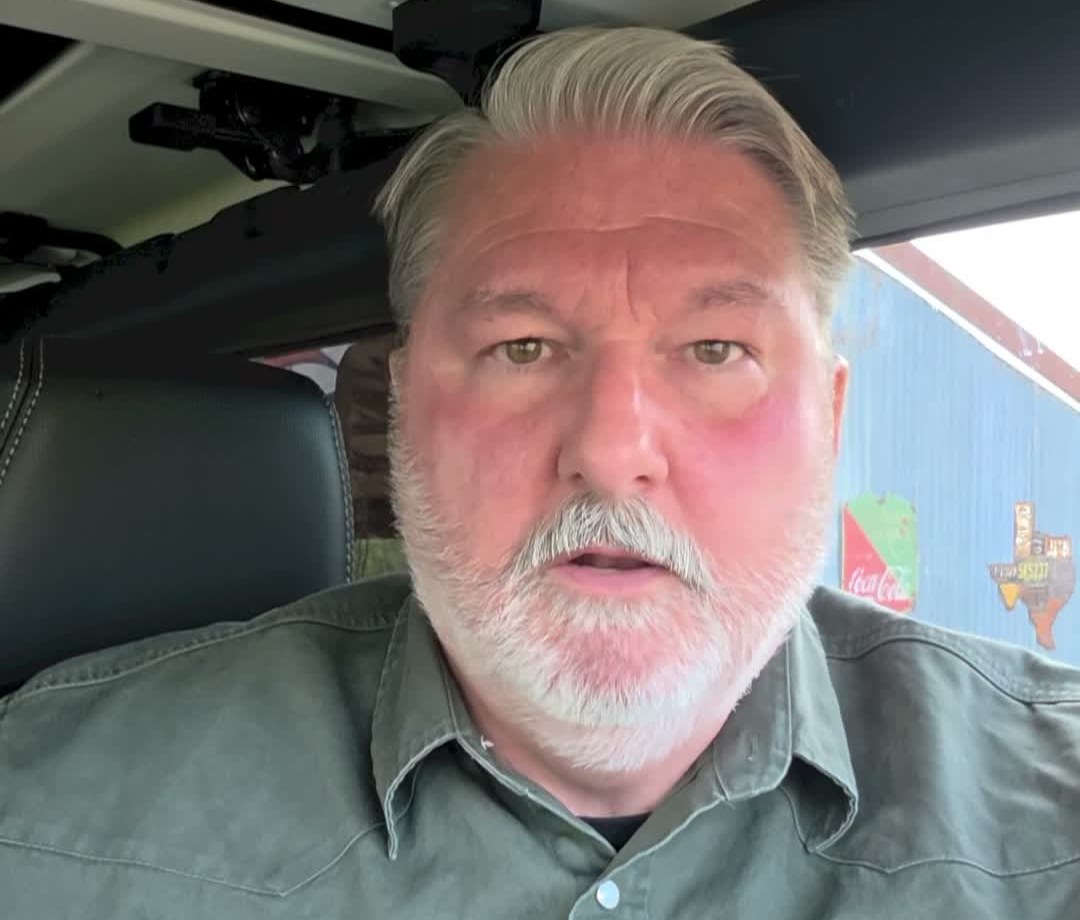
The lead image is a frame from the reel McGowen posted himself on November 15, 2026 — the subject identifying himself, on his own account, in his own words. Its provenance is the post itself; no identification step beyond his self-identification was needed or used. The frame is cropped above the reel’s burned-in text. Named in: Lead.
The 62-second reel this file answers — McGowen, alone, speaking to camera from his vehicle: his name and former office, the accusation against Sergeant Denholm carried in its burned-in overlay, the claim that other deputies were framed by the same group, and a legal-fees fundraiser (Cash App and GiveSendGo G31TC) in the caption, which adds the transfer claim the audio omits. Everything in it is assertion; nothing in it is evidence; and it never names Susan White. It is credited as the video of record; nothing in this file rests on it alone. Named in: §04.
His fundraiser page, read in full: the release date and the time served — 19 years, 4 months, 4 days, out July 14, 2021 — donations forwarded to his attorney of record, and his claim to be the first Texas officer imprisoned for a line-of-duty self-defense shooting, printed in this file as his claim and nothing more. His reels of October 27, 2026 (five more names; “tens of thousands of documents”; 11–13 deputies said to have come forward) and November 2, 2026, his Substack (“overturned four times”), and his November 15, 2026 Instagram post (the Hueske review and the $300,000 fee) — all graded as his allegations. Against them stands the one independent item on his side: Jerry Langton’s Reasonable Doubts (2025), a journalist’s investigation concluding wrongful conviction — reported here as a journalist’s conclusion, which is what it is. Named in: §04.