
Every scandal has a first thread, and in Indianapolis this one has a name. Before there were five criminal cases, before the prosecutor stood up on September 23, 2026 and promised the cases were “definitely just the beginning,” there was a national newspaper’s analysis of publicly available search data, a journalist’s question about one officer’s searches, and then — in early August 2026 — that officer walking into his supervisor’s office to disclose himself. The officer was Michael Rogers, a 16-year patrol officer with the Indianapolis Metropolitan Police Department. His disclosure opened the audit logs, the audits produced five criminal cases, and his own file is where the whole record starts.
Read the posture first, because this file will repeat it until it bores: Rogers is charged, not convicted. Three counts of official misconduct, a felony, and three counts of fraud, a misdemeanor, were filed against him on September 23, 2026, and every act described below is an allegation from the charging documents, stated as an allegation every time it appears. He is presumed innocent unless and until he is proven guilty in court; his own department printed that sentence at the bottom of its announcement, and this file prints it too. His job status, exactly as the record states it: suspended without pay, with his chief’s recommendation of termination sent to the Civilian Police Merit Board — a recommendation, not a firing. No source this file could reach says the Merit Board has acted, and under local ordinance the Board cannot even hold his hearing while his criminal case is pending. (§07, §08)
What the charging documents allege, as the Indianapolis Star reported them from the probable-cause affidavit, is a two-year pattern run through the city’s Flock license-plate cameras: more than 4,400 searches between December 1, 2024 and August 15, 2026, aimed at three people. One license plate — registered to Rogers and his wife — searched about 1,480 times, several times a day on consecutive days, in bursts seconds or minutes apart, under stated reasons the reviewing detective says never matched that plate. His wife’s close friend: 125 searches. A firefighter he believed was his wife’s paramour: about 2,800 searches. The belief is the affidavit’s allegation about Rogers, printed as such; it is not a fact about the firefighter, and none of the three people is named or initialed anywhere in this file — they are private people, and this file prints the counts and the pattern, never the identities. (§05)
The disclosure itself is the hinge of the whole record, and the paper disagrees about it by one day — a disagreement this file prints instead of smoothing. The court documents put his walk into the supervisor’s office on August 7, 2026, after a journalist contacted him. The chief’s own August account put the admission on August 6. What is not in dispute: the Washington Post’s August 19 follow-up investigation made an unnamed Indianapolis officer its lead example — 3,759 searches over ten months in the Post’s dataset window, a different and smaller number than the affidavit’s, printed in this file side by side with it, never merged — and on August 13 the department announced that an unnamed officer had been suspended without pay, the first suspension of the scandal. Rogers stayed unnamed in the department’s paper for five more weeks, until the prosecutor filed. (§03, §04)
This file prints that record at the grade each piece of it earned, and its own limits in the open. The court’s chronological case summary was pulled on November 11, 2026: the cause number prints in this file — 49D35-2609-F6-029191, Marion Superior Court 35 — and the bond, the no-contact order, and the hearing dates print as the docket records them. The docket shows no plea, and this file claims none. (§07, §11)
• Identity: Michael Anthony Rogers — officer, Indianapolis Metropolitan Police Department, 16 years of service at the time of the charges; most recently a patrol officer in the East District. (§01)
• The charges: filed September 23, 2026, by the Marion County Prosecutor’s Office — 3 counts of official misconduct (felony) and 3 counts of fraud (misdemeanor). The first of the five Flock cases to surface, and the one whose disclosure produced the other four. Allegations; case pending. (§07)
• The alleged pattern: more than 4,400 Flock searches, December 1, 2024–August 15, 2026 — about 1,480 of one plate registered to Rogers and his wife, 125 of his wife’s close friend’s, and about 2,800 of a firefighter’s, with roughly 3,825 of the searches falling in 2025 alone; the Washington Post’s dataset, over a different ten-month window, counted 3,759. (§03, §05)
• How it surfaced: the Post’s reporting found the pattern in publicly available search data; court documents say Rogers then came forward to his supervisor in early August 2026; his disclosure triggered the internal audits that produced five criminal cases, and the prosecutor says they are “definitely just the beginning.” (§03, §04, §06)
• The job’s status: suspended without pay — the first suspension of the scandal, announced August 13, 2026 while he was still unnamed — with Chief Tanya Terry’s recommendation of termination before the Civilian Police Merit Board. Not fired on any paper this file could find; by ordinance the Board’s hearing waits on the criminal case. (§08)
• The court’s posture: pending — cause 49D35-2609-F6-029191, Marion Superior Court 35 (docket pulled November 11, 2026). Bond: $5,000 cash, posted September 25, 2026. Initial hearing September 28, 2026: formal reading waived, a no-contact order issued, and no plea shown on the docket. Pretrial conference reset to January 6, 2027, 1:30 PM. (§07, §11)
The paper on Michael Rogers the man is thin, and this file prints it at its true thickness. The court’s docket carries his full name — Michael Anthony Rogers — and that is the form this file uses where his full name prints. What the department’s own announcement carries is a service line: sixteen years with the Indianapolis Metropolitan Police Department. What the chief added in August 2026, while he was still unnamed, is an assignment: he had most recently worked as a patrol officer in the East District. Beyond those two lines, the record behind this file holds no biography — no academy class, no commendations, no prior discipline — and this file invents none.
For five weeks he was not a name at all. On August 13, 2026, IMPD announced the suspension of an officer — unnamed, because the administrative and criminal investigations were still open — and Chief Tanya Terry declined to identify him, saying only that his identity would become a matter of public record if he were criminally charged. A reporter reached Rogers by telephone the next day, August 14, and he declined to comment; a USA TODAY Network reporter who contacted the department about his searches the same day was referred to the announcement. The Indianapolis Star requested his personnel file on August 13; when the Star published on September 23, the department had still not produced it. (§04, §11)
His name entered the public record the way the chief said it would: in the charging announcement of September 23, 2026, where the department listed him first among the five — “Michael Rogers, 16 years — Suspended and recommended for termination.” By then the unnamed officer of August had a face the whole country’s coverage had already described without naming: the Washington Post’s lead example of what a plate-reader network lets one officer do. (§03)
Flock Safety’s cameras read license plates. They sit over roads across Indianapolis, photograph the plates of passing cars, and file each sighting — plate, place, time — into a database an officer can search from a desk. IMPD leases 301 of the cameras, on Chief Tanya Terry’s count of September 9, 2026. (A volunteer census counts more than 550 Flock cameras inside the city across every operator; that is a different count of a wider thing, and this file does not merge the two.) A search of the database leaves a record of itself: who searched, which plate, and whatever reason the searcher typed in.
That reason line is the thread this whole scandal hangs on. In the affidavit the Indianapolis Star reported, the reasons typed against the plates in this file read like routine police work — “hit and run investigation,” “stolen vehicle,” “missing person” — and the detective who reviewed the searches wrote that the plate at the center of them “was never associated with those incidents.” A reason line is only as honest as the officer typing it, and until the summer of 2026, almost nobody was reading the lines back. (§05)
That is the department’s own admission, not this file’s invention: Indianapolis police had no regular practice of auditing officers’ Flock searches until recently, Chief Terry has said in interviews since the scandal broke. The searches accumulated in the log either way — which is why a newspaper’s dataset analysis, and then the audits this file describes at §06, could reconstruct the pattern after the fact. The cameras were always keeping the receipts. The question the record asks is who was ever supposed to read them. (§03, §06, §09)
This case did not start in Indianapolis. It started in a dataset. Flock search logs are, in many jurisdictions, public records, and the Washington Post built an investigation out of them: on August 2, 2026, the Post published a lengthy account of officers across the country misusing Flock cameras, often — in the Indianapolis Star’s summary of it — to stalk women without their knowledge. The logs do not name the people being searched for, but they record the searching, and patterns in them glow: one plate, searched again and again, for months, by one officer.
On August 19, 2026, the Post published its follow-up, and it led with Indianapolis. Its lead example was an unnamed IMPD officer who, the Post’s analysis found, had made 3,759 searches over a ten-month period — about twelve lookups a day — for vehicles used by his wife and two close personal acquaintances. The Post also reported that one of its journalists had asked IMPD about “potentially suspicious (ALPR) activity from one of its officers” at around the time the officer came forward. A separate analysis by USA TODAY, published alongside the Star’s database work in September, examined more than 75 million Flock searches spanning January 2023 to July 2026 across more than 6,300 agencies — the scale of the network this one officer’s pattern was found inside.
• 3,759 searches / ten months — the Washington Post’s dataset analysis (August 19, 2026): one officer, vehicles used by his wife and two close personal acquaintances, about twelve searches a day.
• More than 4,400 searches / December 1, 2024–August 15, 2026 — the probable-cause affidavit, as reported by the Indianapolis Star (September 23, 2026): the charging documents’ count, across a window roughly twice as long.
These are not rival figures and this file does not average them. They are two instruments pointed at the same conduct over different windows: a newspaper’s count of the public logs, and the court’s count from the department’s own records. Each is printed with its window wherever it appears. (§05)
The prosecutor’s verdict on where his cases came from is a quote, and it is printed as one. “A lot of this was initiated by the Washington Post,” Marion County Prosecutor Ryan Mears said. “The Washington Post conducted a review of publicly available information regarding people searching with Flock cameras.” The audits that turned the Post’s unnamed example into five named defendants are at §06. (§06)
The hinge of the whole scandal is a walk into a supervisor’s office, and the paper disagrees about the day it happened — by one day, in print, from the two most authoritative voices in the record. This file prints the disagreement instead of picking a winner.
• August 7, 2026 — the court documents, as reported by the Indianapolis Star on September 23, 2026: Rogers “came forward to his supervisor about his use of the Flock system on Aug. 7.” The Star’s five-officer roundup adds the sequence: he came forward “after he’d been contacted by a journalist.”
• August 6, 2026 — Chief Tanya Terry’s account, as reported by the Star on August 20, 2026: “The officer came forward to his supervisor and admitted misusing the technology on Aug. 6.”
Both accounts agree on the substance — he disclosed himself, to his supervisor, in the first full week of August 2026, as a journalist’s question closed in — and they cannot both be right about the date. The court’s chronological case summary, when pulled, may settle it; until then the day is printed as August 6–7, disputed by one day between the chief’s account and the court documents. (Pull MR-01, §11.)
What followed is not in dispute. The department immediately revoked his police powers and equipment, on the chief’s account, and opened its internal investigation. On August 13, 2026, IMPD announced that an unnamed officer had been suspended without pay for performing — the department’s word that day — “hundreds” of inappropriate searches, and that he was under criminal investigation. The chief declined to name him, placed him as a patrol officer most recently assigned to the East District, and said the department had been working on a new Flock policy for several months before he came forward. The word “hundreds” is preserved here as the announcement’s own characterization; the affidavit’s count, when it came, was in the thousands. (§05)
The next day, August 14, a reporter reached Rogers by telephone; he declined to comment. The department, asked about his searches by a USA TODAY Network reporter that day, referred the question to its announcement. And that is where the public record of Michael Rogers rests for five weeks: a suspended, unnamed officer, a personnel file requested and not produced, and an audit working its way through the search logs his disclosure had opened. (§06)
What follows is the probable-cause affidavit as the Indianapolis Star reported it on September 23, 2026 — the charging documents’ account, printed as allegation in every line. The documents allege that between December 1, 2024 and August 15, 2026, Rogers made more than 4,400 Flock searches with no legitimate law-enforcement purpose, on and off duty, with the bulk of them — about 3,825 — falling in 2025 alone. The searches concentrate on three license plates, and three people who are not accused of anything. None of the three is named in this file, and none is initialed; the charging documents’ pattern is printable, their identities are not this file’s to publish.
The first plate — about 1,480 searches. The plate was registered to Rogers and his wife. A detective who reviewed the searches wrote that they were “being made several times a day on consecutive days with individual searches entered in short intervals of only seconds or minutes apart.” The reasons Rogers typed for them, per the affidavit: “hit and run investigation,” “stolen vehicle,” “missing person.” The reviewing detective’s finding, as reported: that plate “was never associated with those incidents.”
The second plate — 125 searches. It belonged to a close friend of his wife. The searches were made several times a day, with “hit and run accident” and “stolen vehicle” typed in as the reasons. The affidavit records how the friend’s household learned of it: her daughter told a detective “she was aware [Rogers] had been searching her license plate as a reporter had called her about an upcoming story.” The family found out from a journalist — the same press inquiry that stands behind the disclosure at §04.
The third plate — about 2,800 searches. It was registered to an employee of the Indianapolis Fire Department — a firefighter. Prosecutors allege Rogers searched it because he believed the man was having an affair with his wife. Read that sentence at its true weight: the belief is the affidavit’s allegation about what was in Rogers’ mind, attributed to the charging documents every time it appears; it establishes nothing about the firefighter, who is accused of nothing in any paper behind this file. The reasons typed for these searches, again: “hit and run investigation” and “stolen vehicle.”
Set the three counts side by side and the affidavit’s shape is plain: roughly 1,480 searches of the car his own household drove, 125 of her friend’s, 2,800 of the man he suspected — the suspicion searched nearly twice as often as the marriage. Those proportions are the prosecution’s numbers, and they are allegations a court has not tested. But they are the reason a 16-year officer’s own disclosure could not stay a personnel matter: the log he opened was never going to read as a clerical error. (§06, §07)
One officer’s disclosure is a confession. It is also a key. Once Rogers had told his supervisor what the search log held, the department had both the reason and the method to read the log whole — and what the log held was not one officer. In IMPD’s own words, “in August and September 2026, internal audits identified potential misuse of automatic license plate reader (ALPR) technology” by five officers. The department opened administrative and criminal investigations, placed all five on administrative duty with no police powers, and revoked their access to the plate-reader systems; one later resigned while the investigations into her continued. In September, IMPD investigators presented their findings in each of the five cases to the Marion County Prosecutor’s Office.
Five officers were charged on September 23, 2026 out of those audits: Rogers himself; Jonathan Schultz, the 18-year officer whose case carries the scandal’s only stalking counts; and three more officers — four of the five stood suspended with termination recommended when the charges landed, and the fifth had resigned while the investigations into her continued. Every one of those cases traces back through the audit door Rogers’ August disclosure opened — and back, one step further, to a newspaper that asked about his searches first. (§03, §04)
The auditing did not stop at five. A day after the charges, Chief Terry told the Indianapolis Star the department was conducting audits almost daily, with more investigations open and the scope of the misuse still unseen; she declined to say how many officers were being investigated. The department also said its Flock data would not be made public unless it is requested through the Access to Public Records Act. And Prosecutor Ryan Mears, who credited the Washington Post’s review for sparking the audits that produced the September charges, put the forward-looking sentence on the record: these cases are “definitely just the beginning.” (§09)
On September 23, 2026, the Marion County Prosecutor’s Office filed its case, and IMPD announced it the same day. The case is State v. Michael Anthony Rogers, cause 49D35-2609-F6-029191, Marion Superior Court 35, offense date September 16, 2026, and against Rogers the filing carries six counts:
• Counts 1, 3 and 5: official misconduct — Level 6 felonies under Indiana law, which reach a public servant who commits an offense in the performance of his official duties
• Counts 2, 4 and 6: fraud — Class A misdemeanors, under IC 35-43-5-4(a)(3)
The counts are the Marion County Prosecutor’s, as the docket lists them; the charge categories are confirmed in IMPD’s own announcement and were reported from the court documents by the Indianapolis Star. They are allegations. No finding has been made, and he is presumed innocent unless and until proven guilty in court.
The docket, pulled November 11, 2026 — printed here instead of papered over. Bond stands at $5,000 cash, posted September 25, 2026. At the initial hearing on September 28, 2026, formal reading of the charges was waived and the court issued a no-contact order. The docket shows no plea, and this file claims none — the Star’s September 23 reporting that the hearing was then unscheduled and no attorney listed is superseded by the docket entries themselves. The omnibus date is November 30, 2026. The pretrial conference first set for November 12, 2026 was rescheduled to January 6, 2027, at 1:30 PM, on a continuance granted November 4, 2026. Bond and plea reports attaching to any other officer of the five are that officer’s record, and none of it is imported here.
So the posture, precisely: charged September 23, 2026, cause 49D35-2609-F6-029191; case pending in Marion Superior Court 35; pretrial conference January 6, 2027; every act alleged and nothing proven. (§11)
Rogers’ suspension is the scandal’s first, and it was announced before his name was: on August 13, 2026, the department suspended its unnamed officer without pay, his police powers and equipment already revoked at his disclosure. When the charges landed on September 23, the department’s announcement fixed his status in its own sequence: administrative duty with no police powers and ALPR access revoked came first, then suspension, then — for Rogers as for three of the others — Chief Tanya Terry’s recommendation of termination to the Civilian Police Merit Board.
A recommendation is not a firing, and the law keeps it that way. A merit officer who has completed probation cannot be terminated by the chief outright; the strongest discipline the chief can impose alone is a six-month unpaid suspension, on the explanation the Indianapolis Star drew from the department in August. Termination belongs to the Merit Board, after a hearing at which the officer may be represented — and under local ordinance, the Board cannot conduct that hearing while the officer is also criminally charged, until the case is resolved through the court system. So Rogers’ job sits exactly where the paper puts it: suspended without pay, recommended for termination, with the Board’s word unwritten and, by ordinance, unwriteable until the court’s word exists. This file never calls him fired, because no paper this file could find does.
The chief’s public words on the day of the charges belong to all five cases and are printed here as the department printed them: “Today is a deeply disheartening and disappointing day for IMPD. These individuals’ actions went far beyond a clerical error or a violation of department policy. These actions crossed into criminal conduct and shook the foundation of trust that our agency is built upon.” And the announcement’s closing line, which this file adopts as its own posture line: “All individuals charged are presumed innocent unless and until proven guilty in court.”
The rules Rogers allegedly searched under no longer exist, and the paper trail of their replacement begins the same week he came forward. In August 2026 IMPD issued an updated ALPR Standard Operating Procedure. Under it, in the department’s own summary, every search must be tied to a case or incident number and a National Incident-Based Reporting System (NIBRS) offense code; every user had to sign the policy to keep access, and those who did not sign had their access shut off; the department adopted single sign-on, strengthening security against credential sharing; and IMPD now shares its plate-reader data only with law-enforcement agencies inside Indiana — access for agencies outside the state is ended. The department also implemented stronger auditing, meant to catch misuse faster. The SOP is being converted into a General Order that will be public once finalized.
The vendor moved the same week. On August 13, 2026 — the day of Rogers’ suspension announcement — Flock announced safeguards of its own: searches linked to a specific case number, camera data retained for seven days rather than thirty, and software that watches for “abnormal activity” made mandatory rather than optional for departments. What the abnormal-activity software would have made of roughly twelve searches a day of the same household’s plates is a question the record answers by implication: under the old arrangement, nobody’s software and nobody’s supervisor flagged anything; it took a newspaper reading public logs to see the pattern at all. (§02, §03)
On September 9, 2026, Chief Terry carried the proposed general order to the City-County Council’s Public Safety and Criminal Justice Committee: searches tied to a case number and a specific crime; the 301 rented cameras barred from personal use, immigration enforcement, and tracking people at lawful protests, religious services, or seeking reproductive health services; camera data retained thirty days and search history indefinitely. The General Orders Board meeting set for September 15, where the chief was prepared to present the proposal, was canceled when its members could not reach a quorum. The chief also told the Indianapolis Star that the department is now auditing officers’ activity daily, with the help of one of Flock’s own artificial-intelligence tools — the read-back of the search log that did not exist while the searches in this file were being made. (§05, §06)
Every officer file in this library runs the same road sweep, and this one is short because the sweep is empty. Searched November 11, 2026 — his name, with the department named, against speeding, traffic tickets and citations, DUI and drunk driving, crashes and collisions, and driving records, alongside a general arrest-history sweep: no ticket, no DUI, no crash, and no driving matter naming Michael Rogers of IMPD was found. The sweep’s returns were the Flock coverage itself and other men — a 1999 Madison County defendant named Mitchell L. Rogers, an Ohio man named Michael Rogers in a federal computer-hacking case, and Indianapolis officers from other cases and other years. Same names are not the same man, and none of it is printed here as his.
The empty sweep is printed with its scope, as this library always prints it: a search of the reachable paper, not a claim that no record exists anywhere. And it carries the case’s own irony without embellishment. The allegations against Rogers are not about how he drove. They are about a database of where everybody else drove — 301 cameras reading the city’s plates, and one officer prosecutors say turned them on his own household more than four thousand times. (§02, §05)
Every officer file in this library carries a gap register: the paper that should exist, the pull that closes the gap, and an honest label on what has and has not been reached. This file’s register is long for a structural reason — the case is seven weeks old, its charging paper is public mainly through one newspaper’s reading of it, and the defendant was a personnel matter before he was a defendant. Nothing below is smoothed, and nothing anywhere in this file upgrades a search into a fact.
• MR-01 — The Marion County docket (CCS) and cause number: PULLED November 11, 2026 — narrowed. The pull returned cause 49D35-2609-F6-029191 (Marion Superior Court 35, pending), the six counts as listed, bond at $5,000 cash, posted September 25, 2026, the September 28, 2026 initial hearing (formal reading waived; no-contact order issued; no plea shown), the November 30, 2026 omnibus date, and the pretrial conference reset to January 6, 2027, 1:30 PM — all printed at §07. What remains open under MR-01: the one-day disagreement over the disclosure date (§04), which the public docket summary does not settle; the affidavit original may.
• MR-02 — The Merit Board’s disposition on Chief Terry’s termination recommendation: none published in any source this file could reach — and under local ordinance the Board cannot hold the hearing until the criminal case resolves, so no disposition is expected while MR-01 pends. When it lands, §08 updates.
• MR-03 — Law-enforcement certification status (ILEA): not pulled; nothing about his certification is printed anywhere in this file.
• MR-04 — The personnel file: requested from IMPD by the Indianapolis Star on August 13, 2026 and still unproduced when the Star published on September 23; not in this file’s hands either. This file therefore prints no service history beyond the department’s own sixteen-years line and the East District assignment (§01).
• MR-05 — Payroll: no salary figure was pulled for this file, and none is printed. Sixteen years of service is the department’s number; a pay line would be the state’s, and it is not in hand.
• MR-06 — Later docket reporting: at build, searches after the September 23–24, 2026 coverage found no hearing date, plea, bond, or defense filing reported for Rogers. The November 11, 2026 docket pull superseded that: the entries print at §07, and the docket shows no plea. The register reopens the moment anything further prints.
The searches that came back empty are part of the record too: the road sweep at §10, run with its scope printed beside it; any published Merit Board decision after September 23, 2026 (none found). The docket itself was pulled on November 11, 2026 and its entries print at §07. If you hold paper this file lacks — a hearing notice, a board order — send it in. Verified paper runs in this file, dated, and the register above closes line by line.
Every file in the Public Court Records series, in one place. Counties: St. Joseph, Elkhart, Marshall, Allen, Marion, Hamilton, Hancock, Hendricks, Johnson and Sullivan in Indiana; Berrien, Cass and St. Joseph in Michigan; Middlesex in Massachusetts; Muscatine in Iowa; Will in Illinois; St. Tammany Parish in Louisiana; Sussex in New Jersey. Every file is free, forever.
Every material claim in this file traces to a record below. Anything named in this file but not registered here stands in the file as reporting until the paper itself is in hand. Last checked November 11, 2026. The charges in this file are allegations that have not been proven in court.
“Four Suspended IMPD Officers and One Former Officer Charged Following ALPR Misuse Investigations,” September 23, 2026 — the charges against all five officers, Rogers’ 16 years of service and charge categories (fraud, official misconduct), the department’s sequence (administrative duty with no police powers and ALPR access revoked, then suspension, then the termination recommendation to the Merit Board), the audits of August–September 2026, the August 2026 ALPR policy (case/incident number and NIBRS code on every search, signed SOP, single sign-on, Indiana-only data sharing, stronger auditing), Chief Tanya Terry’s statement, quoted at §08, and the presumption-of-innocence line this file carries. Read in full. Named in: Intro, §01, §06–§09.
Ryan Murphy, “Court docs: IMPD officer made 4k Flock searches for wife, friend, firefighter,” September 23, 2026 — the probable-cause affidavit as reported: the more than 4,400 searches of December 1, 2024–August 15, 2026 and their three plates (about 1,480 / 125 / about 2,800), the roughly 3,825 searches of 2025, the stated reasons and the reviewing detective’s findings and wording, the friend’s daughter’s account of learning from a reporter’s call, the August 7 self-disclosure in the court documents, the August 13 suspension announcement and East District assignment, the August 14 declined comment, the unproduced personnel-file request, and the unscheduled initial hearing with no attorney listed in online court records at publication. Read in full. Named in: Intro, §01, §04, §05, §07.
“‘Just the beginning.’ Prosecutor says of 5 IMPD officers charged over Flock use,” September 23, 2026 — the five-officer roundup: Rogers’ three felony official-misconduct and three misdemeanor fraud counts, his coming forward after being contacted by a journalist, Prosecutor Ryan Mears’s “definitely just the beginning” and his crediting of the Washington Post (“A lot of this was initiated by the Washington Post”), the suspensions without pay, and IMPD’s 301 Flock cameras on Chief Terry’s count. Read in full. Named in: Intro, §02, §04, §06, §07.
Ryan Murphy, “What we do — and don’t — know about IMPD’s Flock camera investigation,” August 20, 2026 (updated) — the chief’s August account: the officer’s admission to his supervisor on August 6 (the one-day conflict with the court documents’ August 7 is printed openly at §04), the immediate revocation of police powers and equipment, the department’s “hundreds” of searches, the Post’s August 2 investigation and August 19 follow-up with its 3,759-search count, the absence of any routine audit practice the department has since acknowledged, and the Merit Board’s mechanics — including the ordinance barring a hearing while a criminal case pends. Read in full. Named in: §02, §03, §04, §08.
“IMPD drafts new rules on Flock cameras, now audits officers’ searches daily,” September 11, 2026, and “IMPD Chief says more Flock investigations involving officers ongoing,” September 24, 2026 — the September 9 council-committee presentation of the proposed general order (case number and specific crime; the 301 rented cameras and their barred uses; the chief’s statement that she had recommended firing one unnamed officer — the officer of this file — over 3,759 searches), the daily audits and the Flock artificial-intelligence auditing tool, the canceled September 15 General Orders Board meeting, and the department’s position that its Flock data is public only through an Access to Public Records Act request. Named in: §06, §09.
The Post’s Flock investigations of August 2 and August 19, 2026 — the misuse pattern nationally, the unnamed Indianapolis officer as the follow-up’s lead example, 3,759 searches over ten months for vehicles used by his wife and two close personal acquaintances, and the Post journalist’s question to IMPD about one officer’s suspicious activity at around the time the officer came forward — carried in this file as the Post’s reported findings, via the Indianapolis Star’s and Newsmax’s accounts of them and the Post’s own quoted summaries; the underlying dataset is publicly available Flock search data. The separate USA TODAY analysis of more than 75 million searches (January 2023–July 2026, more than 6,300 agencies) is a different instrument and is registered as such, via the Star’s September 24 database report. Named in: §03.
Public case summary pulled November 11, 2026 — State v. Michael Anthony Rogers, cause 49D35-2609-F6-029191, filed September 23, 2026, pending, offense date September 16, 2026: the six counts as listed (Counts 1, 3, 5 official misconduct, Level 6 felony; Counts 2, 4, 6 fraud, Class A misdemeanor), bond $5,000 cash posted September 25, 2026, the September 28, 2026 initial hearing (formal reading waived; no-contact order issued; no plea shown), omnibus date November 30, 2026, and the pretrial conference rescheduled to January 6, 2027, 1:30 PM (continuance granted November 4, 2026). Other Marion County cases under this name belong to a different man and were not used. Named in: Intro, §01, §07, §11.
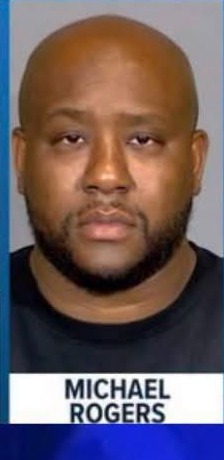
The booking photograph of Michael Rogers (Marion County), carried at the head of this file: a labeled crop from the FOX59/CBS4 broadcast graphic of the five charged officers’ booking photos, his face and printed name in frame, verified against the full graphic preserved in this file’s research pack. sha256 e09e68845905c4ce14df0eb8c91e2c994f38ffbb7657e6e4dc098fd21bf0370d. Named in: the file’s head.
November 11, 2026 — the road sweep at §10 (his name, with the department named, against speeding, tickets and citations, DUI, crashes, collisions, and driving records, plus a general arrest-history sweep: nothing naming him returned; the returns were other men sharing his name, excluded in this file’s research notes and never printed as his); any published Merit Board disposition after September 23, 2026 (none found). The cause number, sought in every outlet, release, and tracker behind this file at build, was located by the November 11, 2026 MyCase pull registered above (MR-01 narrowed at §11); the docket shows no plea for Rogers. Each negative is printed in this file as a search with its scope, never as a claim that no record exists. Named in: §07, §10, §11.
Officers write tickets for every one of these. This section keeps the same record on the officer in this file.
THE CHECKS RUN FOR THIS FILE — NO DOCUMENTED ENTRY FOUND. Searched November 11, 2026 — his name, with the department named, against speeding, traffic tickets and citations, DUI and drunk driving, crashes and collisions, and driving records, alongside a general arrest-history sweep: no ticket, no DUI, no crash, and no driving matter naming Michael Rogers of IMPD was found (§10). The sweep’s returns were the Flock coverage itself and other men — same names are not the same man, and none of it is printed here as his. This section does not claim a certified clean driving record — it reports what the sweep found, and where it cannot reach.
If you photograph or film this officer speeding with no lights on, driving with a light out, rolling through without a signal, parked across a sidewalk or a crosswalk, parked in a handicap space, or breaking any road law you would be ticketed for, send the photo or the video in. Date, time, and place required. Verified submissions run here, dated, with the picture or the footage itself.