
The cameras were never the story. Hancock County’s Flock cameras did what they were built to do: they photographed the cars that passed them, and they kept a log of every officer who came asking where a car had been. The story is what one deputy allegedly did with the asking.
Prosecutors say that between December 1, 2024 and March 16, 2026, Hancock County Sheriff’s Deputy James Heneghan ran 6,196 searches through that license-plate camera network — more than any deputy in his department, every single month, and in May 2025 alone more than a thousand searches, about seventy percent of everything his entire department asked the system that month. And prosecutors say the plates he kept asking about belonged to people in his own life: his wife’s car, searched 901 times; a man who had once known her, searched 922 times; a girlfriend from high school he had barely spoken to in eleven years, and her family, and then — when one of their cars got a new plate — the new plate too.
None of it was caught by an audit. The Flock login screen warned him, every time, that his searches could be monitored, recorded, and audited; his own department required a reason and a case number for every search before the company made those fields mandatory. What caught him, on the record, was a relative walking into a police station in March 2026 carrying threatening text messages — one of which, the complaint says, warned that the relative’s kids would suffer. Indiana State Police took the case. On September 24, 2026, they arrested him, and the Hancock County prosecutor filed seven separate cases in Hancock Superior Court 2. The state police and the court-records reporting put the counts at 441 in total: 220 felony counts of official misconduct, 220 misdemeanor counts of fraud, and one felony count of intimidation — a total the court’s own docket screens, pulled for this file on November 11, 2026, did not verify, and which this file carries as reporting, framed against the seven-case docket structure at §09.
Read the posture first, because this file holds it in every paragraph: James Heneghan is charged, not convicted. He has pleaded not guilty. Everything in this file is an allegation — from the charging documents, the probable-cause affidavit as the court reporting describes it, and the Indiana State Police’s own release — printed at the grade each piece earned, with its source named. Where the paper conflicts, and it does, on the basic question of how much of this searching happened on duty, the conflict is printed whole, in its own section, with every version’s source attached and none of them adopted. Where the paper runs out — five of the seven court cases not yet opened in full, the merit board’s word on his job — the file says so and registers the pull that closes the gap. (§08, §10, §12)
• Identity: James Heneghan — the court papers carry his full name, James Joseph Heneghan IV; most arrest coverage shortens it. Thirty-three years old, a deputy with the Hancock County Sheriff’s Office. He is not the Jackson County deputy in the separate Flock case that aggregators mix him into. (§01)
• The allegation: 6,196 Flock searches in fifteen months, attributed to him by the court records — his wife’s vehicle 901 times, a man who had known her 922 times, a former girlfriend’s family more than 200 times — with the reason “invest” typed on about 5,353 of them. (§03, §04)
• The stop: a car tied to the former girlfriend’s family, searched nine times, was later stopped on the road by Heneghan himself, its driver says — and the same affidavit record notes the car had a broken taillight, which gave the stop an independent basis. Both facts are in this file. (§05)
• The safeguards: a warning on the login screen, a reason and a case number required by his own department — and, by the department’s own account, no audit, alert, or supervisor flagged fifteen months of it. State police built their totals from Flock’s own records after finding duplicates and discrepancies in the agency’s data. (§02, §07)
• The open question: how much of the searching happened on duty is disputed by the sources themselves — the affidavit reporting, the tracker summaries, and the broadcast one-liners do not agree, and this file does not pretend they do. (§08)
• The case: arrested September 24, 2026; the prosecution stands as seven separate cases in Hancock Superior Court 2, all filed September 24, 2026 and all pending — the seven cause numbers print at §09. The reported total is 441 counts (state police and court-records reporting; the docket screens did not verify that total, and one opened case alone carries 50 counts). Not-guilty plea, as reported. In the two cases opened in full, the October 29, 2026 pretrial conference was held and the matter was reset for December 29, 2026, at 9:00 AM; the other five cases print as pending, not opened in full. His department revoked his access in March 2026, put him on paid leave, then unpaid leave after the arrest; the merit board’s termination hearing was still awaited at last report. (§09, §10)
The arrest coverage calls him James Heneghan. The court papers carry the longer name: James Joseph Heneghan IV — the full form appears in a federal court filing that recites his case (a civil complaint about the Flock network nationally, filed in the Southern District of Florida, September 29, 2026) and in the October 12, 2026 write-up built from the Hancock Superior Court 2 records themselves. This file prints the full name because the court record carries it, and says plainly that most of the arrest-day reporting shortened it.
What the record establishes about the man is short, and this file keeps it that short. He is thirty-three years old. He was a deputy with the Hancock County Sheriff’s Office — the county that wraps around the east side of Indianapolis, county seat Greenfield, where state police arrested him on the morning of September 24, 2026. His hire date, his years of service, and his pay do not appear in the sources this file rests on, and none is printed; the pull that establishes them is registered at §12.
One distinction matters enough to print in its own paragraph, because the search engines get it wrong: James Heneghan is not Skylar Thompson. Thompson is a Jackson County deputy charged in a separate Flock case involving 2,055 searches. Different man, different county, different case. Aggregators and image searches mix the two; this file never does, and nothing from Thompson’s case appears anywhere in it.
And one limit matters more than any fact above: as this file publishes, James Heneghan is a defendant with a not-guilty plea on the record, presumed innocent of all 441 counts unless a court says otherwise. The file that follows is the paper — the charges, the affidavit as reported, the department’s own account of its safeguards — and the paper is all it claims to be.
Flock Safety’s cameras are fixed license-plate readers. They photograph passing vehicles — the plate, the time, the place — and hold the images in a searchable network that officers query from a desk or a phone. Type a plate, and the system tells you where that car has been seen, and when. It is, by design, a machine for answering one question: where has this vehicle been?
The same design keeps the receipts. Every search is logged against the officer who ran it, and the court-records write-up records what Heneghan saw each time he signed in: a warning on the login screen stating that access was restricted to authorized purposes and that activity could be monitored, recorded, and audited. His own department went further on paper: the sheriff’s office has said its users were already required to enter a search reason and a case number for every query, before Flock later made those fields mandatory across the system.
So the infrastructure of accountability was all present — the warning, the required reason, the case number, the permanent log. What the log allegedly filled up with, over fifteen months, is the next section. What no one did with the log, until a family complaint forced the question, is §07.
The court records attribute 6,196 searches to James Heneghan between December 1, 2024 and March 16, 2026. The Indiana State Police’s own release put the floor at “more than 6,190”; the affidavit figure, from the Hancock Superior Court 2 records, is 6,196, and that is the number this file carries, attributed to those records every time it appears.
The shape of the fifteen months is what makes the number more than a number. Per the court-records write-up: Heneghan was his department’s top Flock searcher in every month reviewed, and across the whole period he accounted for more than one-fifth of the entire department’s activity. In May 2025 he allegedly ran 1,033 searches — about seventy percent of all Flock use in the Hancock County Sheriff’s Office that month, and twelve times the total of the next-highest deputy.
Every one of those searches required a reason, and the reasons are in the log. On approximately 5,353 of them, the entered reason was a single word: “invest.” On about 508 others, the label was a DUI traffic study. Other entries, the case trackers record, read “police investigation” and “OWI arrest.” What the searches were actually aimed at — again, as the affidavit alleges — is §04. Whether he was on the clock when he ran them is a question the sources fight about, and this file does not settle fights: it is printed whole at §08.
The Indiana State Police said it in one sentence, in its own release: “The searches were specific to people Heneghan was familiar with.” The affidavit, as the court-records write-up reports it, puts the names of the relationships — never printed here — behind three clusters of numbers.
His wife’s vehicle: 901 searches. A man who had previously known her: 922 searches. The two plates cluster in the same months — May 2025, August 2025, February 2026 — and the affidavit describes stretches when the two were queried close together, sometimes within the same minute, with the account frequently accessed from a mobile device. The man, when police reached him, told them he barely knew Heneghan and would not recognize him.
A former girlfriend: more than 200 searches on vehicles associated with her and her family. The affidavit reporting describes a woman who dated Heneghan in high school and had little or no ordinary contact with him for roughly eleven years. When one of the family’s vehicles received a replacement plate, the new tag, in time, began appearing in his search history too.
These are the prosecution’s allegations, printed at that grade: counts from an affidavit this file has read only as the court reporting carries it, about private people this file does not name — not the wife, not the man, not the former girlfriend or her family, here or anywhere. Their names are not the story. The badge, the login, and the log are the story.
One of the searched vehicles eventually met him on the road. The driver, per the affidavit as reported, was the former girlfriend’s stepdaughter, driving a vehicle associated with the family. By then, the affidavit says, that vehicle had been searched nine times through Flock, and its motor-vehicle record accessed five times. The case trackers date the stop to January 2026.
Her account, as investigators recorded it: Heneghan followed closely behind her, accelerating and slowing down, and then stopped her for speeding.
And here is the whole of the record, because this file prints the whole of it: the same affidavit record notes that the vehicle had a broken taillight, providing an independent basis for the stop. That sentence is in the prosecution’s own paper. It does not answer the nine searches that came before the stop, and it does not erase the driver’s account of being followed. It sits beside both, exactly where the affidavit leaves it, and this file leaves it there too. A court — not a summary, not a headline, and not this file — decides what the stop was.
The case did not begin with the searches. It began, in March 2026, when a relative went to the McCordsville Police Department with threatening text messages — messages the relative attributed to Heneghan, one of which warned that the relative’s “kids will suffer.” The relative is a private person; this file prints the role and the words the record carries, and nothing that identifies them.
Sheriff Brad Burkhart referred the complaint out of his own office, and in April 2026 the Indiana State Police took the investigation. The ISP release describes what happened next in its own words: “As the investigation progressed, detectives discovered evidence of improper use of automatic license plate reading cameras.” The intimidation complaint was the thread; pulling it brought up fifteen months of search logs, and the logs became the case — the searches, not the texts, are 440 of the 441 counts.
The department’s own steps ran on their own track: Heneghan’s access to Flock and other restricted databases was revoked on March 26, 2026, and he was placed on paid leave on March 30, 2026. What his employer knew, and when the safeguards should have spoken first, is §07.
Every control the system advertises was in place. The login warning told him his activity could be monitored, recorded, and audited (§02). The department required a reason and a case number for every search. The logs kept everything — 6,196 entries, each one stamped with his account, many of them, prosecutors say, aimed at his own family and a girlfriend from high school.
And by the department’s own account, as the court-records write-up reports it: no internal audit, automated alert, supervisor, or other internal control flagged the activity — not in the month he ran a thousand searches, not in any of the fifteen months — before a relative’s complaint about text messages prompted a closer look. The record does not show a safeguard that failed at the last step. It shows safeguards that were never run.
When state police did run them, they did not trust the county’s copy. Detectives obtained the records directly from Flock and compared them against the data the county supplied; duplicate dates and other discrepancies appeared in the agency material, so the totals in the criminal case were built from Flock’s records, not the department’s. The write-up also records the department’s present tense: Hancock County says it now uses Flock’s Audit Assistance feature daily — the check that, on this record, nobody was running while it mattered.
How much of the searching happened while James Heneghan was on duty? The sources do not agree, the disagreement is basic, and this file adopts no version. The three versions, with their sources:
Version A — the court-records write-up, from the affidavit: more than 3,600 of the searches occurred while he was listed as off duty, another 350-plus while he was on paid time off, and more than 100 while he was using comp time. Separately, and about a narrower set, the same reporting states that department records showed he was working during only about 40 of the roughly 508 searches he had labeled as a DUI traffic study.
Version B — the tracker and video summaries: roughly two-thirds of the searches — about sixty-five percent — were run while he was off duty.
Version C — the broadcast one-line summaries derived from FOX59’s coverage: only about 40 of the searches were on duty — a claim that, set against Version A’s own numbers, appears to take the narrow DUI-study figure and apply it to all 6,196 searches.
All three cannot be true as stated. Version A is the only one that comes out of the court paper itself, and even it this file prints as reporting, not as its own finding. The charging documents — the affidavit itself, pulled from the court file — are the record that settles the duty question, and that pull is registered at §12 (JH-01). Until it lands, any single percentage you see attached to this case, anywhere, is somebody’s compression of a record that does not compress cleanly.
On the morning of September 24, 2026, Indiana State Police served the warrant in Greenfield and booked James Heneghan into the Hancock County Jail. The warrant had been requested by the Hancock County Prosecutor’s Office, working with ISP detectives, on probable cause of intimidation, official misconduct, and fraud. His arrest came one day after five Indianapolis officers were charged in the same statewide Flock scandal — a wave of cases his file stands inside, and which this file mentions only to place his date on the calendar.
Prosecutor Brent Eaton filed the prosecution in Hancock Superior Court 2 — not as one case, the court’s own docket now shows, but as seven separate cases, all filed September 24, 2026, and all pending (Indiana MyCase, pulled November 11, 2026). The seven, with the case-type labels exactly as the docket carries them:
• 30D02-2609-F6-001843 — Fraud MA
• 30D02-2609-F6-001844 — Official Misconduct F6
• 30D02-2609-F6-001845 — Child Seduction F6
• 30D02-2609-F6-001846 — Intimidation F6
• 30D02-2609-F6-001847 — Fraud MA / Official Misconduct F6
• 30D02-2609-F6-001848 — Child Seduction F5
• 30D02-2609-F6-001849 — Official Misconduct F6
Two of the seven were opened in full on the docket. Case -001847 carries 50 counts, alternating fraud (misdemeanors) and official misconduct (Level 6 felonies), with offense dates from September 1 to September 26, 2025; a $5,000 cash bond was posted September 28, 2026. Case -001846 is one count of intimidation (Level 6 felony, offense date February 17, 2026); a $1,500 cash bond was posted September 28, 2026. Neither opened case shows a plea, a disposition, or a sentence. The other five cases were not opened in full in this pull; this file prints them as pending, with their docket labels above, and nothing more.
The state police release and the court-records reporting put the total at 441 counts: • 220 counts of official misconduct — felonies. • 1 count of intimidation — a felony. • 220 counts of fraud — misdemeanors. The arithmetic reconciles across the state police release, the court-records reporting, and a federal court filing that recites the case (221 felonies, 220 misdemeanors). One national roundup called all 441 counts felonies; that is wrong on the face of the reported charge sheet, and this file does not repeat it.
What the docket pull did and did not do: the November 11, 2026 MyCase screens documented the seven-case structure — one opened case alone carries 50 counts — but they did not verify the 441 total, and this file does not upgrade it to docket fact. The reported breakdown also does not, on its face, account for the two child-seduction-labelled cases in the seven (-001845 and -001848, neither opened in full); whether those counts sit inside or outside the reported 441 is an open question this file prints rather than smooths over. (§12, JH-01)
Heneghan pleaded not guilty, as reported — the two dockets opened in full record no plea, and this file keeps the plea at the grade the reporting earned. An initial hearing was set for September 25, 2026, and a pretrial conference for October 29, 2026 — whose outcome, in the two opened cases, is at §10. He is presumed innocent of every count, and nothing after this section should be read in any other light: what a jury, or a plea, or a judge eventually makes of the paper is §10 — and as of this file’s publication, the paper has no ending.
The cases are pending — all seven of them. That is the whole of their ending as this file publishes, and everything below is the record of what has and has not happened since the arrest — printed because a pending case’s silences are part of its record too.
The court’s own docket sheets were pulled November 11, 2026. In the two cases opened in full — 30D02-2609-F6-001847 and 30D02-2609-F6-001846 — the pretrial conference set for October 29, 2026 was held (journal entry filed October 30, 2026), and each matter was reset for a pretrial conference on December 29, 2026, at 9:00 AM. Neither opened case shows a plea, a disposition, or a sentence. The other five cases were not opened in full in this pull; they print here exactly as the docket leaves them: filed September 24, 2026, status pending — their October 29 outcomes, if any were set, are not in hand, and this file does not borrow the two opened cases’ outcome and lend it to them. The posture, exactly: charged September 2026 in seven cases, not-guilty plea reported, cases open, next verified setting December 29, 2026 in the two opened cases. (§09, §12)
His job stands in the same unfinished posture. After the arrest, his paid leave became unpaid leave (one case tracker dates the unpaid status to April, when the allegations surfaced; the state-police sequence puts it after the arrest, and this file follows the state police while registering the variant). The sheriff’s merit board is to consider his termination; when the sheriff’s office answered questions in October 2026, he was awaiting that termination hearing. No disposition has been published that this file could find. He is therefore not called fired, or former, anywhere in this file — he is a deputy on unpaid leave with seven cases pending, and both halves of that sentence are the record.
Every officer file in this library carries a road section, and his is short because the sweep was empty. On November 11, 2026, his name was run against the news archives with the driving terms — tickets, DUI, crashes, driving records — across his full press record: the state police release, the Indianapolis and Greenfield coverage, the court-records write-up, and the case trackers. No ticket, no DUI, no crash, and no driving-record reporting in James Heneghan’s name appears anywhere in that scope. That is a statement about the search, printed with its scope — not a claim about what any database holds.
Two things in this record wear road clothing and are not road infractions, and this file does not let them dress up. The roughly 508 searches labeled with a DUI traffic-study reason (§03) are search-reason entries in a camera log — words he allegedly typed to justify queries, not a driving offense by him. And the January 2026 stop (§05) is part of the criminal allegations, in which he is the officer accused, not a cited driver. What prosecutors say ended this deputy’s road was not a violation on it. It was the log of where everyone else’s cars had been.
This file was built from the paper that could be reached: the Indiana State Police’s release, the affidavit as the court-records reporting carries it, the arrest coverage, a federal filing that recites the case, the case trackers, and — on November 11, 2026 — the court’s own docket sheets for all seven cases, two of them opened in full. What it could not reach, it registers here — the public gap list, in the order the gaps matter. Each pull, when it lands, updates this file at this address; the file is a living record, and its open items are part of it.
• JH-01 — The docket sheets (narrowed Nov 11, 2026). The Indiana MyCase pull of November 11, 2026 documented all seven Hancock Superior Court 2 cases and their cause numbers (§09), and opened two in full — -001847 (50 counts, $5,000 cash bond posted September 28, 2026) and -001846 (one intimidation count, $1,500 cash bond posted September 28, 2026), including the October 29 pretrial outcome at §10. What remains: open the other five cases in full (-001843, -001844, -001845, -001848, -001849 — their counts, bonds, plea entries, and schedules, including whether the child-seduction-labelled cases sit inside or outside the reported 441 total), and the affidavit itself, which is the document that settles the duty question at §08. Anything resting on the five unopened cases stays open, and this file says so.
• JH-02 — The next settings (narrowed Nov 11, 2026). The October 29, 2026 pretrial outcome is settled for -001847 and -001846 (held; reset to December 29, 2026, 9:00 AM). What remains: any filing, outcome, or trial setting in any of the seven cases after the November 11, 2026 pull — next, the December 29, 2026 pretrial conferences — and the October 29 outcome in the five unopened cases.
• JH-03 — The merit board. The Hancock County Sheriff’s Merit Board’s disposition of his termination.
• JH-04 — Certification. His law-enforcement certification status with the Indiana Law Enforcement Academy.
• JH-05 — The service record. Hire date, years of service, and pay, from the county and the state’s Gateway records — the basic career facts the current reporting never printed.
What is not on this list is as deliberate as what is: no pull seeks the identities of the people in the searches. The record that matters is the deputy’s — his login, his log, his counts, and the safeguards that watched all of it happen and said nothing. That record is public, and this file will keep it current at this address.
Every file in the Public Court Records series, in one place. Counties: St. Joseph, Elkhart, Marshall, Allen, Marion, Hamilton, Hancock, Hendricks, Johnson and Sullivan in Indiana; Berrien, Cass and St. Joseph in Michigan; Middlesex in Massachusetts; Muscatine in Iowa; Will in Illinois; St. Tammany Parish in Louisiana; Sussex in New Jersey. Every file is free, forever.
Every material claim in this file traces to a record below. Anything named in this file but not registered here stands in the file as reporting until the paper itself is in hand. Last checked November 11, 2026.
News release, September 24, 2026 (published in full by WBIW; reported the same day by the Indianapolis Star, WTHR, WISH-TV, and WIBC) — the April 2026 start of the investigation after the threatening-text allegations; “detectives discovered evidence of improper use of automatic license plate reading cameras”; “The searches were specific to people Heneghan was familiar with”; the release’s own “more than 6,190” search floor; the warrant requested by the Hancock County Prosecutor’s Office with ISP detectives; the September 24 arrest and booking; the leave that began when the allegations were first made. Named in: Intro, §03, §04, §06, §09.
The docket sheets for all seven cases, all filed September 24, 2026 and all pending — 30D02-2609-F6-001843 (Fraud MA), -001844 (Official Misconduct F6), -001845 (Child Seduction F6), -001846 (Intimidation F6), -001847 (Fraud MA / Official Misconduct F6), -001848 (Child Seduction F5), -001849 (Official Misconduct F6) — with two cases opened in full: -001847 (50 counts, alternating Fraud MA and Official Misconduct F6, offense dates September 1–26, 2025; $5,000 cash bond posted September 28, 2026) and -001846 (one count of Intimidation F6, offense date February 17, 2026; $1,500 cash bond posted September 28, 2026); in both opened cases, the October 29, 2026 pretrial conference was held (journal entry filed October 30, 2026) and reset for December 29, 2026, at 9:00 AM, with no plea, disposition, or sentence. The other five cases were not opened in full. The screens did NOT verify the reported 441-count total. Named in: Intro, §09, §10, §12.
The court-records write-up of October 12, 2026, built from the Hancock Superior Court 2 records and the probable-cause affidavit — the 6,196 searches (December 1, 2024–March 16, 2026); the 901 and 922 clusters and their months; the former-girlfriend cluster and the replacement plate; the May 2025 figures (1,033 searches, about seventy percent of the department’s month, twelve times the next deputy); the top-searcher-every-month and one-fifth-of-the-department findings; the “invest” and DUI-study reason counts; the duty-status figures printed at §08 as Version A; the stop and the broken taillight; the login warning and the reason-and-case-number requirement; the safeguards passage; the Flock-records comparison; the access, leave, and merit-board sequence; and the 220/220/1 count sheet. This file’s spine, graded as court records at one remove — the affidavit itself is pull JH-01. Named in: Intro, §01–§10.
Second Amended Complaint, Case No. 2:26-cv-14319-AMC, ECF 36 (filed September 29, 2026), ¶110 — a civil plaintiff’s pleading about the Flock network nationally, used in this file for exactly two things: the full name form, “James Joseph Heneghan IV,” and the independent reconciliation of the charge arithmetic (441 counts: 221 felonies, 220 misdemeanors). It is not used for any fact about Heneghan’s conduct. Named in: §01, §09.
“Hancock County deputy arrested on misconduct charges,” September 24, 2026 — the arrest-day record from the ISP release: the April 2026 investigation start, the improper-use finding, the leave, the warrant, the booking, and his age, 33. The Star’s October 8, 2026 Kokomo coverage places his charging in the statewide wave (its “charged September 25” wording is loose against the release’s September 24 arrest and the September 25 initial hearing, and the release governs). Named in: Intro, §01, §06, §09.
The September 24, 2026 arrest coverage and the October court follow-ups — the booking photograph’s original graphic (FOX59/CBS4, see the photograph card below), the leave sequence (the ISP/WISH line this file follows), and the broadcast summaries whose competing duty-status compressions are printed at §08 as Versions B and C rather than adopted. Named in: §06, §08, §10.
The Heneghan entry in the Indiana Flock-misuse tracker — the “roughly two-thirds off duty” summary (Version B at §08), the January 2026 dating of the stop, the September 25 initial-hearing setting, and the leave variant registered at §10 (unpaid leave dated to April). A compiled tracker, graded below the court paper wherever the two overlap, and cited where it stands alone. Named in: §05, §08, §09, §10.
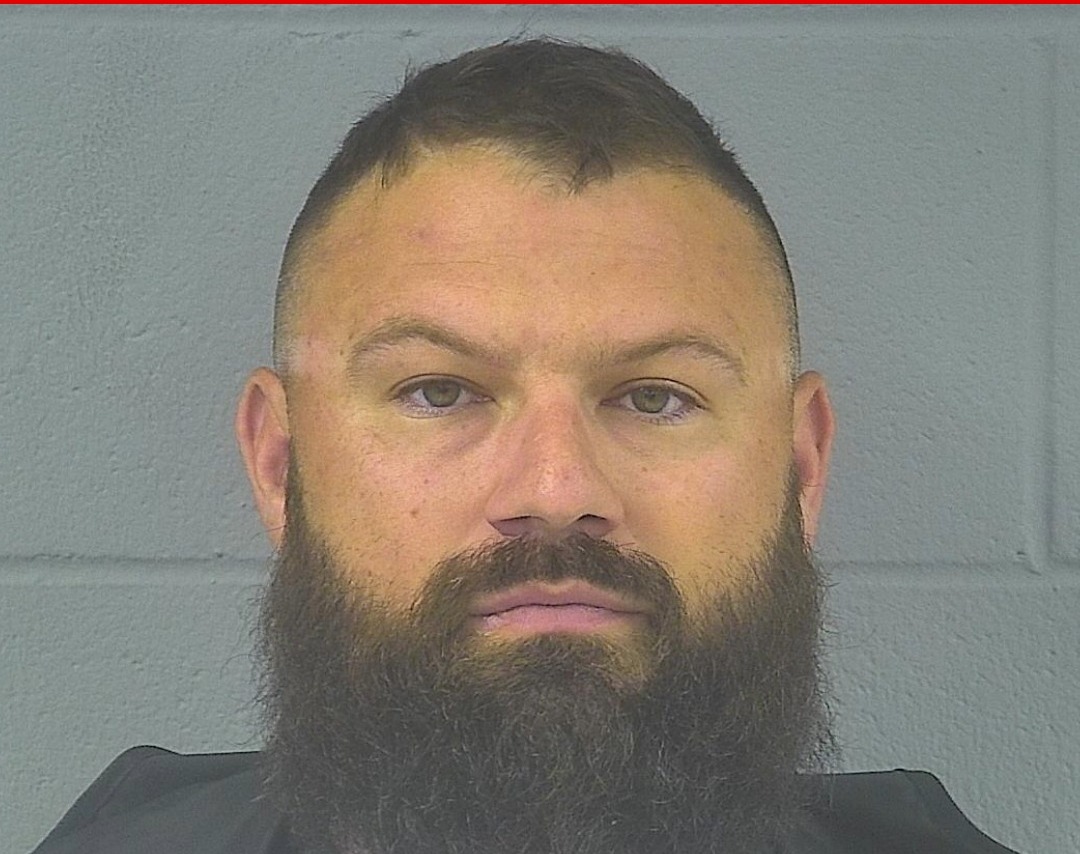
The booking photograph of James Heneghan (Hancock County Jail, September 2026), carried at the head of this file, cropped from FOX59/CBS4’s news graphic of the same photograph: the crop removes the graphic’s headline band and frame, and nothing else — the booking photograph itself is untouched. The scan verified the graphic carries his Hancock County Jail mugshot against independent descriptions of the booking photo. It is not the Jackson County deputy of the separate case. Named in: the file’s head.
November 11, 2026 — the cause numbers (sought first in the ISP release, the Star, WTHR, WISH-TV, FOX59, the court-records write-up, and the federal filing, and not located there; then pulled the same day from Indiana MyCase — all seven print at §09); the October 29, 2026 pretrial conference outcome (no coverage located in reporting; the docket pull above carries it for the two opened cases only, with the other five not opened in full); any merit board disposition after October 12, 2026 (none found); the road sweep at §11 (his name against tickets, DUI, crashes, and driving records across his full press record; nothing returned); his hire date, service length, and pay (not in any source read). Each negative is printed in this file as a search with its scope, never as a claim that no record exists. Named in: §01, §09–§12.
Officers write tickets for every one of these. This section keeps the same record on the officer in this file.
THE CHECKS RUN FOR THIS FILE — NO DOCUMENTED ENTRY FOUND. On November 11, 2026, his name was run against the news archives with the driving terms — tickets, DUI, crashes, driving records — across his full press record: the state police release, the Indianapolis and Greenfield coverage, the court-records write-up, and the case trackers. No ticket, no DUI, no crash, and no driving-record reporting in James Heneghan’s name appears anywhere in that scope (§11). That is a statement about the search, printed with its scope — not a claim about what any database holds. Two things in this record wear road clothing and are not road infractions, and this section does not let them dress up: the roughly 508 searches labeled with a DUI traffic-study reason (§03) are search-reason entries in a camera log — words he allegedly typed to justify queries, not a driving offense by him — and the January 2026 stop (§05) is part of the criminal allegations, in which he is the officer accused, not a cited driver.
If you photograph or film this officer speeding with no lights on, driving with a light out, rolling through without a signal, parked across a sidewalk or a crosswalk, parked in a handicap space, or breaking any road law you would be ticketed for, send the photo or the video in. Date, time, and place required. Verified submissions run here, dated, with the picture or the footage itself.