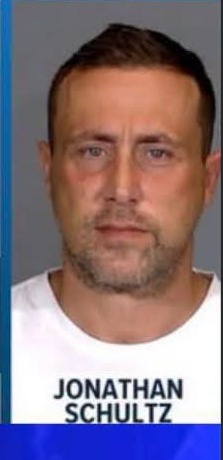
On September 23, 2026, the Marion County Prosecutor charged five Indianapolis police officers with misusing the city’s Flock license-plate cameras. Four of the five cases are about searches — thousands of them, run on wives, ex-partners, and people the officers knew. The fifth case, the one in this file, is different in kind, and the prosecutor said so out loud: Jonathan Schultz is the only one of the five charged with stalking, because prosecutors allege he did not stop at looking. They allege he used the camera network to arrange run-ins — to be standing in the gym, in the parking lot, in the path of women he did not know, at the moment they arrived.
Read the posture first, because this file will repeat it until it bores: Schultz is charged, not convicted. Twenty-six counts — twelve of official misconduct, twelve of fraud, two of stalking — were filed against him on September 23, 2026, and every act described below is an allegation from the charging documents, stated as an allegation every time it appears. He is presumed innocent unless and until he is proven guilty in court; his own department printed that sentence at the bottom of its announcement, and this file prints it too. His job status, exactly as the record states it: suspended, with his chief’s recommendation of termination sent to the Civilian Police Merit Board — a recommendation, not a firing. No source this file could reach says the Merit Board has acted. (§08, §09)
What the charging documents allege, as the Indianapolis Star reported them from the probable-cause affidavit, is a pattern that ran for three years: roughly 1,396 Flock searches between 2023 and 2026, aimed at about a dozen license plates, most of them belonging to women he did not know. A woman from his exercise class, searched 70 times after she blocked his messages. A woman whose gym sign-ins matched his on nine days in a single summer, searched 98 times, who told investigators she still does not feel safe. A note left on a windshield, signed with his first name and his phone number. A woman whose stolen car he was assigned to investigate, searched 300 times — beginning months before the car was ever stolen. And his ex-wife, searched 22 times before, during, and after their divorce — he was charged and arrested, the Star noted, exactly one year to the day after she filed to end the marriage. (§04–§07)
This file prints that record at the grade each piece of it earned, and it prints its own limits in the open. The court’s chronological case summary was pulled on November 11, 2026: the cause number prints in this file — 49D36-2609-F6-029117, Marion Superior Court 36 — and the bond and the trial dates print as the docket records them. One limit stands exactly where the docket leaves it: the public case summary records no plea, so the one not-guilty-plea report in circulation is still printed as reported, not as docket fact. The women are private people: the charging documents identify them by initials, and this file does not — it prints counts and pattern, never identities. (§08, §11)
• Identity: Jonathan Schultz — officer, Indianapolis Metropolitan Police Department, 18 years of service at the time of the charges. (§01)
• The charges: filed September 23, 2026, by the Marion County Prosecutor’s Office — 26 counts: 12 official misconduct, 12 fraud, 2 stalking. The most charges of the five officers charged that day, and the only stalking counts, because prosecutors allege he used the camera data to arrange in-person run-ins. Allegations; case pending. (§08)
• The alleged pattern: roughly 1,396 Flock searches, 2023–2026, aimed at about a dozen plates, mostly women he did not know — including 70 searches of an exercise-class acquaintance, 98 of a gym member, 300 of a woman whose stolen-car case he worked, and 22 of his ex-wife. (§04–§07)
• How it surfaced: a fellow officer’s August 2026 self-disclosure triggered internal audits of IMPD’s plate-reader searches; the audits produced five criminal cases, and the prosecutor says they are “definitely just the beginning.” (§03)
• The job’s status: suspended — the suspensions were reported as without pay — with Chief Tanya Terry’s recommendation of termination before the Civilian Police Merit Board. Not fired on any paper this file could find; the Board’s word is unpublished. (§09)
• The court’s posture: pending — cause 49D36-2609-F6-029117, Marion Superior Court 36 (docket pulled November 11, 2026). Bond: $5,000 cash + $5,000 surety. The docket records no plea. Final Pretrial Conference February 4, 2027; Jury Trial February 8, 2027. (§08, §11)
Of the five officers in this file’s story, Jonathan Schultz is the one the public record knows the least about outside the charges — and this section prints exactly what the paper carries, no more. He is an officer of the Indianapolis Metropolitan Police Department with 18 years of service, on the department’s own count in its September 23, 2026 announcement — the longest service of the five officers charged that day. The announcement gives no assignment, no district, and no rank for him, and no coverage this file could reach supplies them, so this file does not guess at any of the three.
The one earlier piece of paper that names him is a court’s. On February 23, 2014, IMPD Officer Jonathan Schultz answered a dispatch about a person waving a firearm at the Washington Point Apartments, saw the butt of a handgun under a driver’s seat, and arrested the driver, Tyrone Grayson. Grayson’s conviction was upheld by the Indiana Court of Appeals on March 8, 2016, in an opinion that walks through Schultz’s work that night step by step and finds it lawful. It is carried here for one reason only: it is the verifiable shape of the job he held for eighteen years — a patrol officer whose arrests were written up in appellate opinions — before the only story with his name in it became this one. It is a service record, not a blemish, and this file does not dress it as either more or less than that.
Beyond that, the biographical paper runs out, and this file says so rather than filling the silence: no date of birth, no hometown profile, no prior-discipline record, and no salary figure appears in the sources behind this file, and none is printed. What exists is a charging record, a department announcement, and the affidavit reporting of the Indianapolis Star — and those are the sections that follow.
Flock Safety cameras are license-plate readers: fixed cameras that photograph every plate that passes and log it into a searchable network — plate, time, place — that an officer with access can query from a desk. Indianapolis runs one of the country’s larger networks. IMPD leases 301 Flock cameras, on Chief Tanya Terry’s count in September 2026; the probable-cause affidavit in this case describes IMPD as having access to roughly 300 Marion County Flock cameras. (A larger figure — 550-plus — circulates from the DeFlock project; it counts every camera operator in the city, not IMPD’s network, and this file does not use it.)
The power and the danger of the system are the same fact: a search is invisible to the person searched. The driver whose plate passes a camera gets no notice, no letter, no knock. The only witness to a search is the audit log — which means the only thing standing between an officer and the movements of any driver in the city was, until August 2026, the officer’s own purpose. The charging documents in the five September cases allege what happened when that was the only lock on the door: searches with no case, no call, and no law-enforcement purpose at all — thousands of them, across five officers, aimed largely at the women in their lives and, in the case in this file, at women who were strangers.
The department’s own announcement describes the door as it stands now, after the fact. In August 2026 IMPD issued an updated ALPR standard operating procedure: every user had to sign it to keep access, and those who did not lost access. Every search must now be tied to a case or incident number and a National Incident-Based Reporting System offense code. Single sign-on replaced shared credentials; auditing was strengthened; and IMPD stopped sharing its plate data with any agency outside Indiana. The SOP is being converted into a public General Order. The alleged misuse in all five cases, the department notes, happened before that policy — in the years when a search needed no reason anyone would ever check. (§03)
The scandal did not start with a victim’s complaint or a journalist’s lawsuit. It started, on the Indianapolis Star’s reporting, when one of the five officers charged in September — Michael Rogers — disclosed his own misuse of the plate-reader system to a supervisor in August 2026, after a reporter’s questions reached him. IMPD’s announcement tells the institutional half of the same story: internal audits in August and September 2026 identified potential misuse of the automatic license-plate-reader technology by five officers, and the department opened administrative and criminal investigations.
The sequence matters, because it is the audit — not any single complaint — that produced the case in this file. Chief Terry first placed all five officers on administrative duty with no police powers and revoked their access to the plate-reader systems. As facts emerged in each investigation, she suspended the four who remained and recommended their termination to the Civilian Police Merit Board; the fifth officer resigned. In September, IMPD investigators presented their findings to the Marion County Prosecutor’s Office, and on September 23, 2026, prosecutors filed charges against all five.
Marion County Prosecutor Ryan Mears did not present the five cases as the end of anything. They are, he said, “definitely just the beginning,” and he confirmed the department is investigating additional cases of Flock misuse. Five officers in one announcement is already, on the Star’s account, among the largest single roundups of its kind in the country. The audit that produced it began with one officer walking into his supervisor’s office — and it is still running.
Everything in this section and the three that follow is allegation: the Indianapolis Star’s account of the probable-cause affidavit filed in Marion Superior Court and unsealed in September 2026. The women in it are private people. The court documents identify them by initials; this file does not reproduce even that — it prints the counts and the pattern, and nothing that could name them.
The exercise class. Investigators say the pattern’s first page is a fitness class in late 2023. A woman who attended it told investigators Schultz showed what she called a “weird obsession” with her, and that after she missed a session she began receiving Facebook messages from an account under the name “Huztlez Smith” — apparently his alias, investigators say — including, on September 29, 2023, the message “You look smoking hot.” She blocked the account. Nine days later, investigators allege, he began running her license plate through Flock. The documents identify that as the earliest unauthorized search in the case. It did not end quickly: prosecutors allege 70 searches of her plate over roughly two and a half years, the most recent on May 15, 2026.
The gym. A second woman’s account is the heart of the stalking charge. Prosecutors allege that around November 2025 Schultz introduced himself to her as an FBI agent, and later walked into her workplace to tell her not to be alarmed if she saw him in the parking lot — he was, he allegedly said, on official surveillance. Text messages from an unfamiliar number followed. Gym records, investigators say, then showed the two signing in within an hour of each other on nine days between June 12 and August 1, 2026 — and on at least three occasions, he allegedly Flock-searched her car shortly before scanning his own gym card. The total alleged searches of her plate: 98. On August 12, 2026, she photographed his license plate, reported him to gym staff, and left. The affidavit records the investigators’ summary in one sentence: “She says she still does not feel safe.”
Prosecutors allege there were others who never met him at all: three more women, tracked through the cameras, who told investigators they had never interacted with him — two who lived in his Greenwood apartment complex, and one who belonged to the Greenwood gym. They knew nothing about the searches. That is the design of the tool, and the allegation in one line: the only person who knew was the person doing the searching. (§05, §06)
Still allegation, still the affidavit as the Star reported it — and this is the count that separates this file from the other four cases charged on September 23, 2026. A woman who belonged to a Greenwood gym found a note on her windshield on July 3, 2026. The court records quote it; this file paraphrases it, because the note speaks for itself in the charging documents and needs no amplification here: a man she did not know introduced himself on paper, wrote that he had seen her at the gym, signed it with his first name — Jonathan — and left his phone number. FOX59’s reporting on the court documents adds the scale behind the note: the car it was left on had allegedly been searched through the camera network more than 170 times in three months.
Investigators allege the note was not the only approach: at least three more encounters followed elsewhere, including on September 4, 2026 at the Greenwood Walmart — nineteen days before he was charged. Set the sequence side by side and the stalking counts explain themselves. A search is a look. One hundred seventy searches of one car, a note on its windshield, and appearances in the places its driver goes are, on the prosecution’s theory, something else: the camera used as a scheduling device, so that chance encounters could be manufactured on demand.
That is precisely what Prosecutor Ryan Mears said when the charges were announced. Of the five officers, Schultz alone faces stalking counts, Mears explained, because he alone is accused of using the camera data to arrange run-ins with the people he tracked. The other four cases allege watching. This one alleges showing up. (§04, §08)
Allegation again — the affidavit’s account, as reported — and on its own facts the strangest search pattern in the case, because this one began inside a real police investigation. On June 23, 2024, a woman’s car was stolen from the Greenwood Mall parking lot, and Schultz met her in the course of the case. The documents allege he had already been looking: he had run her plate through IDACS — the Indiana Data and Communications System — on February 10, 2024, more than four months before the theft, and had run the first of his Flock searches of her car on March 7, 2024. The total alleged searches of that one plate: 300.
The documents divide the 300 with unusual care. Eighteen of them were run while the car was actually stolen — the window in which a search could wear the costume of police work. The other 282, running as recently as August 1, 2026, “appear to have no legitimate law enforcement purpose,” in the documents’ own words. The two later dated for a time, investigators allege, and he seemed always to know where she and another man she was seeing had been. The charges reach all of it: prosecutors charged searches tied to her plate, to the other man’s, and to the plates of two former gym employees.
Read the dates in order and the affidavit’s point makes itself: the searches did not begin with the stolen car. They preceded it by months, continued through the eighteen that the theft could explain, and then continued for two more years after it could not. (§04, §07)
The last pattern in the affidavit is the one the other four cases share — the search turned inward, on a life the officer actually lived. Prosecutors allege that Schultz ran his now-ex-wife’s plate through the camera network 22 times — before, during, and after their divorce, which the record dates to February 2026. She is a private person. Her name does not appear in this file, and the only facts about her printed here are the ones the charging story cannot be told without: the 22 searches, and the calendar.
The calendar is the detail the Star closed its account on, and it is printed here as the paper printed it: she filed to end the marriage exactly one year before the day he was charged and arrested. One year to the day — September 23, 2025 to September 23, 2026. The Star tried to reach her for its story and could not; she has said nothing in public about any of it, and nothing in this file puts words in her mouth.
Twenty-two searches is the smallest number in this file. It is included because it completes the affidavit’s shape: the classmate who blocked him, the gym member who reported him, the woman whose case he worked, the strangers in his apartment complex — and, threaded through the same years and the same system, the woman he had been married to. The allegation is one pattern with many doors, and every door was a license plate. (§04–§06)
The Marion County Prosecutor’s Office charged this case publicly on September 23, 2026, and IMPD announced it the same day; the court’s docket carries the filing date as September 22, 2026 — both dates print here, as their records state them. The probable-cause affidavit was unsealed in Marion Superior Court, on the Indiana Lawyer’s reporting. The case is State v. Jonathan Schultz, cause 49D36-2609-F6-029117, Marion Superior Court 36, offense date September 16, 2026, and the filing carries 26 counts:
• 12 counts of official misconduct — Level 6 felonies
• 12 counts of fraud — Class A misdemeanors
• 2 counts of stalking — Level 6 felonies; his alone, of the five officers
The counts are the Marion County Prosecutor’s, as the docket lists them; the charge categories are confirmed in IMPD’s own announcement and were reported from the court documents by the Indianapolis Star. They are allegations. No finding has been made, and he is presumed innocent unless and until proven guilty in court.
The docket, pulled November 11, 2026 — printed here instead of papered over. Bond stands on the docket at $5,000 cash + $5,000 surety ($10,000 total). At the initial hearing on September 25, 2026, the court advised him of his rights and the defense waived formal reading of the charges — and the public case summary records no plea. Secondary reporting carried by WIBC and relayed by case trackers reports a not-guilty plea; this file prints that plea strictly as reported, because the docket itself shows none, and it will not present a plea as settled that the court’s own summary does not record. The trial track: the pretrial set for October 28, 2026 was cancelled on an agreed continuance (October 26, 2026); the Final Pretrial Conference is February 4, 2027 and the Jury Trial is February 8, 2027. No defense attorney was listed in the online court records before the Star published on September 23.
So the posture, precisely: charged September 2026, cause 49D36-2609-F6-029117; case pending in Marion Superior Court 36; jury trial February 8, 2027; every act alleged and nothing proven. (§11)
His employment status is printed in this file exactly as the record states it, because the difference between the words is the difference between a decision and a recommendation. On IMPD’s own announcement: after the audits surfaced, Schultz was placed on administrative duty with no police powers, and his access to the plate-reader systems was revoked. As the investigation developed, Chief Tanya Terry suspended him — the suspensions of the four remaining officers were reported as without pay — and recommended his termination to the Civilian Police Merit Board. The Board is the body that decides. No source this file could reach reports that it has decided, and so this file never calls him fired. He is a suspended officer awaiting a board’s word and a court’s verdict, in that order of certainty about neither.
The chief’s own words on the day the charges were announced are part of the record, and they are printed as she said them: “Today is a deeply disheartening and disappointing day for IMPD. These individuals’ actions went far beyond a clerical error or a violation of department policy. These actions crossed into criminal conduct and shook the foundation of trust that our agency is built upon.” And the department’s announcement closes with the sentence this file has carried from its first paragraph, because it is the law of the case until a court says otherwise: “All individuals charged are presumed innocent unless and until proven guilty in court.”
Two of the decisions that will end this story are therefore still unwritten — the Merit Board’s on the job, and the court’s on the charges. Both are registered as open pulls at §11, and this file will be updated in place when either lands. (§08)
Officers write tickets for every one of these. This section keeps the same record on the officer in this file.
NO DOCUMENTED ENTRY FOUND. No road infraction naming Jonathan Schultz — no ticket, no traffic case, no DUI, no crash report, no driving matter — was found in the sources searched for this file. The scope of that statement is exact: on November 11, 2026 this file searched his name, as an IMPD officer and with the department named, against speeding, traffic tickets and citations, DUI, crashes, collisions, and driving records, across his full press record and the wider web. What came back was this case itself, other officers’ unrelated driving cases, and the 2014 on-duty arrest an appellate opinion records at §01 — lawful duty, not a road infraction, and not dressed as one. No certified court-records pull naming him is in this file’s hands, and this section does not claim one. The irony needs no underlining: the allegations in this file are not about how this officer drove. They are about what the city’s cameras let him watch.
If you photograph or film this officer speeding with no lights on, driving with a light out, rolling through without a signal, parked across a sidewalk or a crosswalk, parked in a handicap space, or breaking any road law you would be ticketed for, send the photo or the video in. Date, time, and place required. Verified submissions run here, dated, with the picture or the footage itself.
Every officer file in this library carries a gap register: the paper that should exist, the pull that closes the gap, and an honest label on what has and has not been reached. This file’s register is longer than most, because this case is seven weeks old and its court paper is still thin in public. Nothing below is smoothed, and nothing anywhere in this file upgrades a search into a fact.
• JS-01 — The Marion County docket (CCS) and cause number: PULLED November 11, 2026 — narrowed. The pull returned cause 49D36-2609-F6-029117 (Marion Superior Court 36, pending), the 26 counts with their levels, bond at $5,000 cash + $5,000 surety, and the trial track — all printed at §08. One limb stays open: the public case summary records no plea (the September 25, 2026 initial hearing was a rights advisement; formal reading was waived), so the reported not-guilty plea stays labeled reported-only (§08) until a docket entry records one.
• JS-02 — The Merit Board’s disposition on Chief Terry’s termination recommendation: not published in any source this file could reach. When it lands, §09 updates.
• JS-03 — Law-enforcement certification status (ILEA): not pulled; nothing about his certification is printed anywhere in this file.
• JS-04 — Defense filings: none in the located record. The next-hearing-date limb closed with the November 11, 2026 docket pull: Final Pretrial Conference February 4, 2027; Jury Trial February 8, 2027.
• JS-05 — Payroll: no salary figure was pulled for this file, and none is printed. Eighteen years of service is the department’s number; a pay line would be the state’s, and it is not in hand.
The searches that came back empty are part of the record too: the road sweep at §10, run with its scope printed beside it; any published Merit Board decision after September 23, 2026 (none found). The docket itself was pulled on November 11, 2026 and its entries print at §08. If you hold paper this file lacks — a hearing notice, a board order — send it in. Verified paper runs in this file, dated, and the register above closes line by line.
Every file in the Public Court Records series, in one place. Counties: St. Joseph, Elkhart, Marshall, Allen, Marion, Hamilton, Hancock, Hendricks, Johnson and Sullivan in Indiana; Berrien, Cass and St. Joseph in Michigan; Middlesex in Massachusetts; Muscatine in Iowa; Will in Illinois; St. Tammany Parish in Louisiana; Sussex in New Jersey. Every file is free, forever.
Every material claim in this file traces to a record below. Anything named in this file but not registered here stands in the file as reporting until the paper itself is in hand. Last checked November 11, 2026 (docket pull the same day). The charges in this file are allegations that have not been proven in court.
“Four Suspended IMPD Officers and One Former Officer Charged Following ALPR Misuse Investigations,” September 23, 2026 — the charges against all five officers, Schultz’s 18 years of service and charge categories (stalking, fraud, official misconduct), the audit sequence (administrative duty with no police powers and ALPR access revoked, then suspension, then the termination recommendation to the Merit Board), the August 2026 ALPR policy (case/incident number and NIBRS code on every search, signed SOP, single sign-on, Indiana-only data sharing), Chief Tanya Terry’s statement, quoted at §09, and the presumption-of-innocence line this file carries. Read in full. Named in: Intro, §01–§03, §08, §09.
Ryan Murphy, “Court docs: IMPD officer tracked women through Flock, arranged run-ins,” September 23, 2026 — the probable-cause affidavit as reported: the 26 counts (12 official misconduct, 12 fraud, 2 stalking), the roughly 1,396 searches, the exercise-class account (the alias account, the September 29, 2023 message, the nine days, the 70 searches), the gym account (the FBI-agent allegation, the nine matching sign-in days, the 98 searches, “She says she still does not feel safe”), the July 3 windshield note (paraphrased in this file; the phone number in it is not printed), the 300 searches of the stolen-car complainant’s plate with the IDACS search of February 10, 2024, the 22 searches of his ex-wife’s plate and the one-year calendar, and the absence of a listed defense attorney at publication. Read in full. Named in: Intro, §04–§08.
“‘Just the beginning.’ Prosecutor says of 5 IMPD officers charged over Flock use,” September 23, 2026 — the five-officer roundup, Prosecutor Ryan Mears’s “definitely just the beginning,” the suspensions without pay as the department announced them, IMPD’s 301 Flock cameras on Chief Terry’s count, and the case-number policy proposal. Read in full. Named in: Intro, §02, §03, §09.
September 23, 2026 — the probable-cause affidavit unsealed in Marion Superior Court, and the affidavit’s description of IMPD’s access to roughly 300 Marion County Flock cameras. Named in: §02, §08.
Anna Darling, September 24, 2026, from the court documents — the arranging of run-ins, the gym appearances, and the plate searched more than 170 times in three months with the note left on the car; carried in this file’s research pack and attributed where used. Named in: §05. The booking photograph at the head of this file is a labeled crop from this coverage’s five-officer graphic; see the photograph card below.
Public case summary pulled November 11, 2026 — State v. Jonathan Schultz, cause 49D36-2609-F6-029117, filed September 22, 2026, pending, offense date September 16, 2026: the 26 counts as listed (12 official misconduct, Level 6 felony; 12 fraud, Class A misdemeanor; 2 stalking, Level 6 felony), bond $5,000 cash + $5,000 surety, the September 25, 2026 initial hearing (rights advisement; formal reading waived; no plea recorded), the October 28, 2026 pretrial cancelled on an agreed continuance, Final Pretrial Conference February 4, 2027, and Jury Trial February 8, 2027. Named in: Intro, §08, §11.
September 2026 — initial court proceedings for the five officers beginning the week of September 28, 2026. Named in: §08. The secondary report of a not-guilty plea (WIBC, relayed by case trackers) remains registered in this file as reported only: the November 11, 2026 docket pull records no plea. The bond the trackers carried as a flat $10,000 is carried on the docket as $5,000 cash + $5,000 surety.
Grayson v. State, Case No. 49A05-1505-CR-350 (March 8, 2016) — the opinion recording Officer Jonathan Schultz’s February 23, 2014 dispatch response and arrest at Washington Point Apartments, and upholding the conviction. A service record; no misconduct is alleged in it. Named in: §01.
The booking photograph of Jonathan Schultz (Marion County), carried at the head of this file: a labeled crop from the FOX59/CBS4 broadcast graphic of the five charged officers’ booking photos, his face and printed name in frame, verified against the full graphic preserved in this file’s research pack. sha256 0ee9985905ef8ee0d7c58a41b6a9d10da150646584db205aa378caf22adf6545. Named in: the file’s head.
November 11, 2026 — the road sweep at §10 (his name, with the department named, against speeding, tickets and citations, DUI, crashes, collisions, and driving records: nothing naming him returned); any published Merit Board disposition after September 23, 2026 (none found). The cause number, sought in every outlet and release behind this file at build, was located by the November 11, 2026 MyCase pull registered above (JS-01 narrowed at §11). Each negative is printed in this file as a search with its scope, never as a claim that no record exists. Named in: §08, §10, §11.