
Ric Bradshaw has been Sheriff of Palm Beach County, Florida, since January 4, 2005 — the sixteenth sheriff since the agency’s origin in 1909, and the longest-serving in the county’s history (Palm Beach County Sheriff’s Office, executive staff biography). Every part of the record in the situation file — File No. 134, THE PALM BEACH COUNTY SHERIFF’S OFFICE FILE — happened inside his tenure: the 2008 decision to grant Jeffrey Epstein work release; the paid permit detail of 91 deputies and $128,136 that staffed it; the December 11, 2008 federal warning his office answered by continuing the program for seven more months; the destroyed visitor log; and the state investigation that closed in 2021 with two findings this library prints together wherever either appears — Epstein received “differential treatment,” and there was no evidence any deputy was coerced, bribed, or engaged in criminal activity.
This file is the command record: the man, the decisions his office made under his authority, the explanations his office gave as the record grew, and his own public answer when the state finished — a statement, on May 10, 2021, welcoming the findings that cleared his office of criminal wrongdoing and recorded its differential treatment of the prisoner in the same reports.
His chief deputy through the Epstein period — the warning letter’s copy recipient and the agency’s voice in its defense — has his own file: No. 136, THE MICHAEL GAUGER FILE.
Bradshaw’s career, as his office states it: a law-enforcement professional of more than five decades who rose through the ranks of the West Palm Beach Police Department and was appointed its Chief of Police in 1996. On January 4, 2005, he was sworn in as Sheriff of Palm Beach County — the county’s sixteenth sheriff, and now its longest-serving (PBSO executive staff biography, read November 14, 2026). The office he leads is the largest law-enforcement agency in the county: ten departments, some 4,300 employees and roughly 1,600 volunteers (same source).
He was sheriff for three years when Epstein surrendered to his stockade in July 2008. He was sheriff when the Herald exposed the detail in 2018, sheriff when the Governor ordered the state investigation in 2019, and sheriff when it reported in 2021. He remains sheriff today, in a sixth term won on November 5, 2024 (§05). No part of the Epstein custody record in this library predates or postdates his command of the agency that held the prisoner; that continuity is the reason this file exists.
The full record is File No. 134; the command facts are these. In the fall of 2008, Bradshaw’s office granted a convicted sex offender work release the federal prosecutors said he was ineligible for, over a written policy fight his own spokeswoman’s statements never settled (§03), without the sentencing judge (Attorney General Moody, August 8, 2019), and over the U.S. Attorney’s Office’s hand-delivered warning of December 11, 2008. The program ran seven months past that warning. Its supervision was a paid detail of his deputies — 91 of them, $128,136, October 10, 2008 through July 21, 2009 — posted in a lobby while the prisoner received visitors behind a closed door, driving him to his mansion to wait in the driveway, and logging visitors on a log his office later destroyed “pursuant to records retention schedules.”
Where did the decision sit inside the agency? The office answered that question itself, on the record, in 2018: asked about the work-release decision, spokeswoman Teri Barbera told the Herald that “the sheriff has the final decision” (as reported in the 2026 Gauger investigation). This file does not need to speculate about the chain of command; the agency stated it. What no source pulled shows is Bradshaw personally directing the detail’s day-to-day terms — that limit is printed at §06, and it is part of his record too.
The warning letter itself was addressed to his office and copied to his chief deputy, Michael Gauger — the officer with direct authority over the corrections division that administered work release (Gauger’s own professional biography; File No. 136). The letter asked to be kept informed of any change in Epstein’s status. The terms were later loosened; the U.S. Attorney’s Office was not notified (Acosta’s letter to victims’ counsel, File No. 134, §04).
An agency’s explanations are its sheriff’s record, and this office’s explanations moved as the record grew. Printed in sequence:
2018. Spokeswoman Teri Barbera provided the Miami Herald a copy of the office’s work-release policy — the copy the Herald reported specifically bars sex offenders from the program — while maintaining that Epstein “met the criteria for the Work Release Program.” Of the supervision, the office’s voice was Chief Deputy Gauger: a deputy “stayed with him the entire time he was at his office”; Epstein was allowed no family, friends, or guests — “His attorney or business partner ONLY”; and deputies filed over 464 reports (Gauger, as quoted by WPTV).
2019. Barbera told WPTV: “Sex offenders are not allowed to go on work release. Epstein registered as a sex offender after he was released from jail.” The two statements sit side by side in this file because they sit side by side in the record: in 2018 he met criteria the policy appeared to deny him; in 2019 the rule was stated absolutely and his registration was moved past his release.
The contradiction underneath. The visitor record assembled from the surviving documents — a 2011 court filing’s count of roughly 67 visits by one frequent visitor, later reported confirmed by jail logs; 2026 testimony describing Ghislaine Maxwell as a frequent office visitor — contradicts the no-guests account the office gave (File No. 134, §05, at its grades). The log that would have settled it was destroyed by the office itself. FDLE’s investigators later wrote that destroyed records were among the factors that hampered their work (Associated Press, May 2021).
After the Herald’s November 2018 investigation, Bradshaw began an internal investigation of his own office’s handling of Epstein. In August 2019, Governor Ron DeSantis ordered the Florida Department of Law Enforcement to take over the criminal investigation — of the sheriff’s office and of the State Attorney’s office, across 2005–2009.
FDLE’s three reports issued in March 2021. Printed together, as this library prints them everywhere: Epstein received “differential treatment” — the agents said so three times in their analysis — and FDLE found no evidence that any sheriff’s deputy, State Attorney Barry Krischer, or any of his prosecutors “was coerced, bribed or engaged in any criminal activity in the performance of their duties,” determining that both agencies adhered to the laws and rules in place at the time (FDLE reports, as reported by Politico and the Associated Press, May 2021). FDLE also recorded, against the Herald’s policy account, that departmental policy at the time did not bar sex offenders from work release and that three other sexual-offender inmates had been authorized for the program (Associated Press).
On May 10, 2021, Sheriff Bradshaw issued his answer: he welcomed the findings (Politico; OK Magazine, May 11, 2021). The criticism of the investigation he welcomed is part of the same record: FDLE proceeded with no search warrants, no subpoenas, and no grand jury (former FBI agent Stuart Kaplan), and its agents recorded that destroyed records, conflicting memories, the death of a key witness, and some victims’ refusals to talk had hampered the inquiry (Associated Press). A clearance reached without compulsory process, of an office whose own log destruction the investigators noted, is printed in this file at exactly that full description — no stronger, and no weaker.
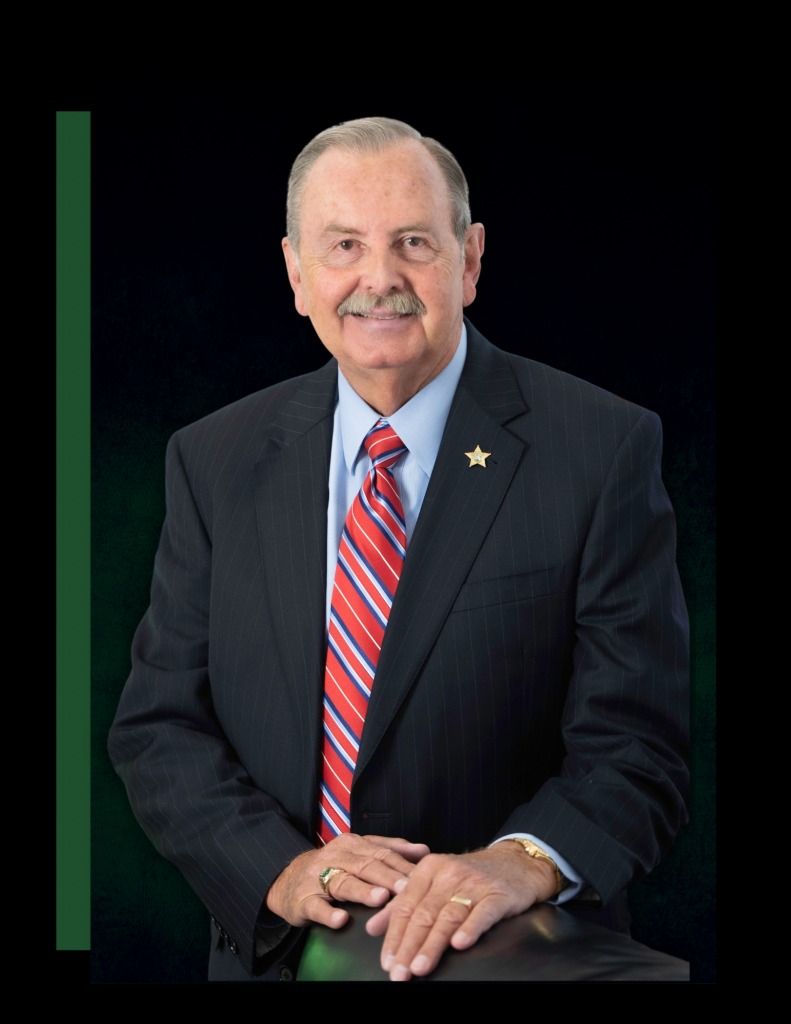
Bradshaw’s tenure did not end with the investigation; it lengthened. On November 5, 2024, he was re-elected to a record sixth term, defeating his former chief deputy, Michael Gauger, by roughly 16 points (intake record; the race is also File No. 136’s closing chapter). As of this file’s build date, November 14, 2026, his office’s own executive staff page still lists him as Sheriff, and this file’s lead portrait is the one published there.
His broader documented record as the county’s long-serving sheriff includes a second Palm Beach Post investigation, unrelated to Epstein and printed here as the separate matter it is: in June 2024 the Post reported, from payroll records, that Bradshaw had built an executive retirement-benefit program — begun as early as 2014 — under which at least three departing executives received payouts of more than $400,000 each, the largest being Gauger’s $743,000 in administrative-leave benefits, plus more than $110,000 for unused sick and vacation time; four executives’ payouts totaled just under $2 million (Palm Beach Post investigation, June 27, 2024 — every figure the Post’s, from the payroll records it examined). A spokeswoman told the Post the benefits were needed to retain talented leadership. That is his office’s financial-management record as documented by the county’s newspaper of record; it is printed here because a sheriff’s file is the whole of his command, not only its worst chapter.
When the Epstein detail resurfaced in November 2026 — the FDLE-derived count of 91 deputies carried to a mass audience on November 9–12 — no response from Bradshaw or his office appears in any source pulled for this file as of November 14, 2026 (135-01). His office’s standing answer remains the one given in May 2021.
Accuracy runs in both directions, and this section is part of the file, not a courtesy.
No source pulled for this file shows Bradshaw personally setting the detail’s daily terms — the lobby posting, the driveway waits, the expansion dates. The command responsibility is documented (§02); personal direction of the particulars is not, and this file does not print it.
No investigation has found that Bradshaw took anything from Epstein or his foundation. FDLE’s 2021 finding — no evidence any deputy or prosecutor was coerced, bribed, or criminal — covers his command, and this file prints it at §04 in full, beside the differential-treatment finding, every time. A 2026 research article’s observation that Bradshaw bought homes in the years after 2009 — offered by its own author with the concession that no evidence links any financial benefit from Epstein to him — is not printed as a claim anywhere in this file; it is recorded in this file’s claims ledger as examined and excluded, with the reason.
And the reel that carried this story to Facebook in November 2026 does not name him at all. This file exists because the documented record does — not because a 15-second text card said so.
This file prints its open items in the open. Each pull below closes one, and the file will be updated at this same address when the paper lands.
As of November 14, 2026, no statement by Bradshaw or his office responding to the resurfacing of the 91-deputy count appears in any source pulled. When one is given, it prints at §05 and in this file’s update history — in his office’s own words, under this library’s standing subject-response practice.
Shared with File No. 134 (134-01): the March 2021 reports’ own text, including the differential-treatment passages and the passages on the grant, in FDLE’s words rather than the reporting’s.
Bradshaw began an internal investigation in 2019 before FDLE took over. Its file — scope, findings, and any discipline considered — has not been pulled; what his office concluded about itself, before the state arrived, is not in any source pulled for this file.
Every file in the Public Court Records series, in one place. Counties: St. Joseph, Elkhart, Marshall and Allen in Indiana; Berrien and Cass in Michigan; Middlesex in Massachusetts; Sussex in New Jersey. Every file is free, forever.
Every material claim in this file traces to a record below. Reporting is credited to the outlet that did it. Where a source could not be reached in full, the file says so on its face. Last checked November 14, 2026.
The sheriff’s office’s executive staff page — sworn in January 4, 2005; sixteenth sheriff since 1909; the county’s longest-serving; West Palm Beach police chief from 1996; the agency at 4,300 employees and ten departments; and the lead portrait published at the head of his biography. The agency’s own labeling fixes the portrait’s identity. Named in: Intro, §01, §05.
The grant, the warning letter, the 91 deputies and the $128,136, the destroyed log, and the mansion escorts are documented in full in File No. 134 from the Miami Herald (November 28, 2018), WPTV (July 17, 2019), the FDLE reports as reported (May 2021), Attorney General Moody’s August 8, 2019 statement, and the 2026 research reporting on the released files. This file’s §02–§04 rest on that record and do not re-derive it. Named in: §02, §03, §04.
“The sheriff has the final decision” — Barbera’s answer on the work-release decision, carried in the February 2026 Gauger investigation’s account of her Herald statements. Printed at §02 attributed exactly so. Named in: §02.
His public answer to the FDLE findings — he welcomed them — reported the day the findings became public, alongside the findings themselves and the no-warrants/no-subpoenas/no-grand-jury criticism (Stuart Kaplan). Named in: Intro, §04.
The Post’s investigation of the executive retirement-benefit program, from payroll records: payouts of more than $400,000 to at least three departing executives; the largest, $743,000 in administrative-leave benefits plus more than $110,000 in unused sick/vacation, to former Chief Deputy Gauger; four executives’ payouts totaling just under $2 million; the spokeswoman’s retention rationale. A separate matter from the Epstein record, printed as such at §05 with every figure attributed to the Post. Named in: §05.
Bradshaw’s re-election to a record sixth term, defeating Michael Gauger by roughly 16 points — as carried in the intake record and the 2024 campaign coverage (Palm Beach Post). Named in: Intro, §05.
Officers write tickets for every one of these. This section keeps the same record on the officer in this file.
NONE DOCUMENTED YET. If you photograph or film this officer speeding with no lights on, driving with a light out, rolling through without a signal, parked across a sidewalk or a crosswalk, parked in a handicap space, or breaking any road law you would be ticketed for, send the photo or the video in. Date, time, and place required. Verified submissions run here, dated, with the picture or the footage itself.