This is the institutional file of the case that ended the career of Air Force Special Operations Command’s senior enlisted leader. Its spine is five dates, each on the record: a concealed-camera report made to a school resource officer on April 9, 2025 (§02); a command chief relieved for loss of confidence five days later (§04); a seventeen-month investigation by the Air Force Office of Special Investigations (§03); charges preferred on November 13, 2025 (§05); and a general court-martial at Hurlburt Field that convicted and sentenced on September 17, 2026 (§06–§07). The man at the center of it — Chief Master Sgt. Anthony W. Green, AFSOC’s 11th command chief — is File No. 122, THE ANTHONY GREEN FILE. This file is the command’s paper: what was reported, what the institution did, and what its own releases say.
The case reached this library through a September 18, 2026 public post — a twenty-second text-card summary published the day after the sentencing. Every material claim in it was graded against the Air Force’s own release and the courtroom reporting before this file was built: the post’s claims survived almost point for point, its sentence figure was exactly right against a wrong one circulating beside it, and its single inaccuracy was an omission in the defendant’s favor — it left out the indecent-recording conviction (§08). Files in this library are not built because a post says so. This one is built because the official record underneath the post holds.
The fence that governs the whole case governs here: the victim is a minor — the command chief’s stepdaughter, fifteen during the offenses as the court record states — and she is referred to by role only: no name, no initials, no school, no identifying detail, in this file or in File No. 122. Her mother is carried by role only as well. The offenses are stated at the grade of the charges and the court record. What the record does not contain — and it does not contain several things the public conversation assumes — is set out in the open in §08.
Air Force Special Operations Command, headquartered at Hurlburt Field in Okaloosa County, Florida, is the Air Force’s special-operations major command — roughly 21,000 Total Force Airmen (SOFREP’s figure), led by a lieutenant general and, on the enlisted side, by a Command Chief Master Sergeant: the senior enlisted adviser to the commander and the enlisted standard-bearer for the force.
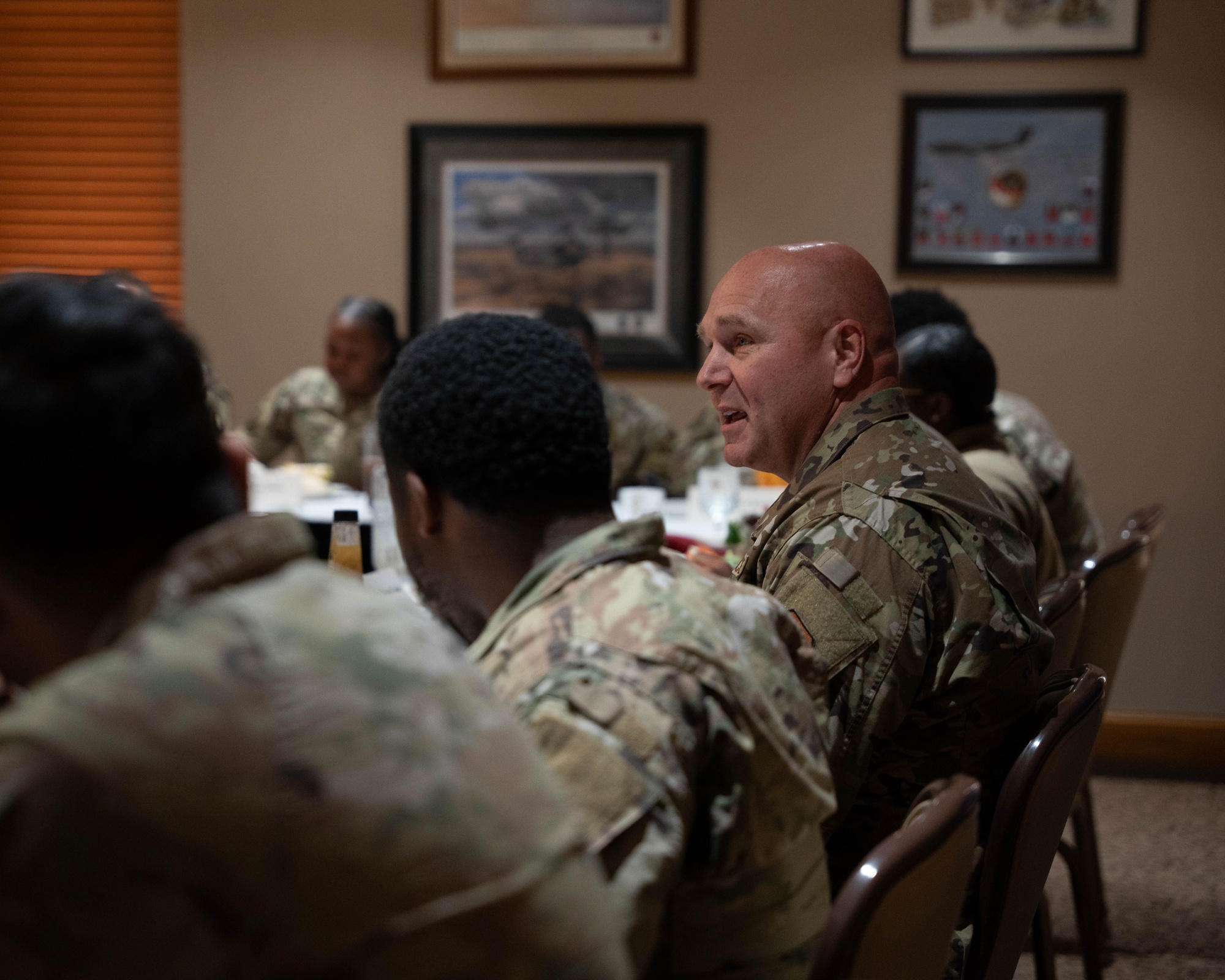
The airman who held that post from May 2023 was Anthony W. Green — the command’s 11th command chief, a chief master sergeant (E-9, the highest enlisted grade) with roughly three decades of service behind him (File No. 122, §01). The photograph on this file’s front is the post as it looked from inside: Green on duty at Cannon Air Force Base on March 10, 2025, talking with Air Commandos at a luncheon — an official duty of the office, performed while, on the prosecution’s proven case, the conduct of §02 was underway in his home.
That is the institution this file follows: not a rogue airman at the edge of an organization, but the man the command had placed at the top of its enlisted force — and the machinery that moved, in sequence, once a report reached it.
The first institutional fact of this case is a child walking into the right office. The particulars are the prosecution’s case as reported from the courtroom by Mid Bay News, carried by SOFREP and OAF Nation, and are attributed as reporting; the Air Force’s release records the offenses only as committed “on or near Hurlburt Field, against one victim.”
On April 8, 2025, the command chief’s stepdaughter found a live feed of her own bedroom on his phone, mounted in his truck. She confronted him that day; per her testimony he handed her one camera from inside an air purifier and told her it was the only one. The next morning, April 9, 2025, she reported the secret filming to Melissa Vause, a School Resource Officer in Okaloosa County, and Vause alerted the Air Force Office of Special Investigations. A redacted Okaloosa County incident report of the episode describes alleged video voyeurism involving a minor.
With the consent of the victim’s mother, AFOSI agents searched the home and the truck and found what the one handed-over camera was not: a second camera in the bedroom, its microSD card holding footage, and a third camera in the truck. The prosecution’s case, as reported, counted three hidden cameras in the bedroom — disguised as a surge protector, a wall charger, and inside an air purifier, all aimed at the bed. The sequence that matters institutionally is the short one: a report on April 9, a federal investigative agency engaged the same day, and a command decision inside the week (§04).
The investigation belonged to the Air Force Office of Special Investigations, Detachment 121, at Hurlburt Field. By AFOSI’s own account — published after the verdict and syndicated September 29, 2026 — the detachment worked the case for roughly seventeen months, from the April 2025 concealed-camera report to the September 2026 court-martial. AFOSI’s account names Special Agent Mason Gray and Special Agent Daniel Brooks, the detachment’s senior leader, among the agents on the investigation.
What the investigation produced, on the record, is the prosecution’s trial case (File No. 122, §05): the cameras and their purchase trail, the viewing application and its relabeled alerts, the viewing time in the days before discovery, and the digital-forensics evidence — testified to by Josiah Roloff of Roloff Digital Forensics — that tied the production specification to the phone. The investigative record itself, beyond what was presented in open court and reported from the room, has not been published; this file claims nothing from it that the courtroom record does not carry.
On April 14, 2025 — five days after the report of §02 — AFSOC commander Lt. Gen. Michael Conley relieved Green as command chief “due to a loss of confidence in his ability to fulfill his duties.” The command announced the relief the next day, April 15, and its spokesperson, Lt. Col. Becky Heyse, confirmed that an investigation was ongoing and declined to detail it (Air Force Times, Defense News, and Air & Space Forces Magazine, April 2025).
Two facts about the relief are worth holding at their exact size. First, its speed: the interval between a school resource officer’s report and the removal of a major command’s senior enlisted leader was five days, and the command said so on the record, by name, in the standard language of relief. Second, its limit: a relief for loss of confidence is a command action, not a finding — it decided nothing about guilt, and this file does not print it as one. What it decided was the post. The charges took seven more months (§05).
Conley appears once more in this record, in a different chair: at the September 2026 sentencing he testified as a character witness for the man he had relieved, attesting to Green’s strong military character (File No. 122, §05). Both appearances are in the record; this file prints both.
On November 13, 2025, charges were preferred against Green (the date as carried by SOFREP’s courtroom-based account; the month corroborated by OAF Nation; the docket confirmation is an open item, §09). The Department of the Air Force Office of Special Trial Counsel — the Air Force’s independent trial-counsel office — preferred, referred, and prosecuted the case. The charge sheet as disclosed by the Air Force carried five specifications: one of indecent recording (Article 120c, UCMJ); three under Article 134 — possessing, viewing, and producing child pornography, in the release’s own words; and one of obstruction of justice. The full specification table, with each result, is File No. 122, §04.
The public docket of the Air Force Judge Advocate General carried the case on its way through: an Article 32 preliminary-hearing entry — the military’s preliminary screening of charges bound for a general court-martial — projected for February 10, 2026, styled U.S. v. CMSgt A. Green, Hurlburt Field. The offense list carried at that preliminary stage differed in part from the final charge set; where the two differ, the Air Force’s September 2026 release controls, and this file follows the release. The date the charges were formally referred to the general court-martial rests today on a single social-media post (May 2026) and is carried as unverified in §09 — printed as an open item, not as a fact.
Green pleaded not guilty to all of it.
The general court-martial sat at Hurlburt Field from September 14 to 17, 2026, before a military judge sitting alone, at Green’s election. Mid Bay News covered all four days from the courtroom; this section follows that reporting, carried by SOFREP and OAF Nation, and is attributed as reporting.
The government’s case was the record of §02 and §03 presented in the room: the victim’s testimony, her mother’s testimony that she never knew of or authorized the cameras, and the forensic evidence from the phone. The defense theory was a parent’s right to monitor a child in his own home while he traveled — an argument the judge ruled presented no reasonable affirmative defense, and which prosecutors answered on two grounds: that parental rights would not protect the conduct charged, and that they would not extend to a stepparent in any event.
On September 17, 2026, the judge convicted Green of the indecent-recording specification and of all three child-pornography specifications — possessing, viewing, and producing — and acquitted him of obstruction of justice. The Air Force announced the verdict the same day. One institutional fact is missing from every word of that paper, and §08 prints the absence: no release and no item of coverage this file rests on names the military judge.
The sentence adjudged September 17, 2026, as the Air Force’s release states it: ten years’ confinement for producing; two years each for indecent recording, possessing, and viewing — “those sentences will run concurrently” — for a total confinement of ten years; reduction to the grade of E-1; and a dishonorable discharge. Production alone carried a thirty-year maximum under the UCMJ. The component table and the arithmetic — including the correction of the “14 years” figure circulating in summaries of this case — are File No. 122, §06.
At sentencing, Green gave an unsworn statement calling his conduct an “enormous mistake” and asking to be spared the dishonorable discharge; the judge imposed it. His character witnesses were the commander who had relieved him, Lt. Gen. Conley, and a former AFSOC command chief, Cory Olson, who called Green’s military character “impeccable.”
The Air Force’s release closed with the institution’s own words, printed here whole:
“AFSOC is committed to the welfare of our Airmen and maintaining good order and discipline to preserve the trust placed in us to execute our critical global missions.”
— Air Force Special Operations Command release, September 17, 2026.
And the sentence’s posture, stated as plainly here as in File No. 122, §07: September 17 is the sentence as imposed. A dishonorable discharge carries mandatory review by the Air Force Court of Criminal Appeals under Article 66(b)(1)(A), UCMJ, and the discharge is not executed until the case is final on appeal. No docket entry for this case appears in that court’s public docket as of November 14, 2026. This file will print the review’s outcome at this address when the record carries it.
This section exists so the gaps sit in the open, at the same size as the facts. Each item below is something the public conversation about this case assumes, asserts, or needs — and that the paper pulled for this file does not contain.
The confinement total is ten years, not fourteen. Summaries of this case circulating on social media have printed “14 years.” The figure drops one of the adjudged two-year terms and ignores the concurrency the Air Force’s release states in plain words. The terms are 10 + 2 + 2 + 2, running together: ten years total (File No. 122, §06). The originating post that brought this case to the library had the figure right; the copies that repeated it wrong are answered here, once, and not repeated as fact anywhere in either file.
The military judge is unnamed. Not in the AFSOC release, not in its DVIDS mirror, not in the courtroom coverage, not in the day-after verdict reporting. This file prints the absence and pulls the docket (§09); it does not guess a name onto a bench.
The place of confinement is not in the record. No release and no reporting pulled states where Green is confined. Assertions about a facility circulating in social-media comment threads are unverified and appear nowhere in this file as anything but this sentence’s subject: an unproven claim, not carried.
No state case appears. Beyond the redacted Okaloosa County incident report of April 2025, no Florida state charge — filed, declined, or pending — appears in any reporting pulled. Whether the state acted in parallel to the court-martial is unknown on this record, and is printed as unknown.
The discharge is not final. The dishonorable discharge is adjudged, not executed: Air Force Court of Criminal Appeals review is required before the case is final, and nothing in that court’s public docket yet carries this case (§07). Any account of this case that prints the discharge as a completed fact is ahead of the paper.
This file prints its open items in the open. Each pull below closes one, and the file will be updated at this same address when the paper lands.
The Air Force Judge Advocate General’s docket record for U.S. v. Green (Hurlburt Field): the presiding military judge’s name (§08), the referral date (§05), and docket confirmation of the November 13, 2025 preferral date, which today rests on courtroom-based reporting.
The Air Force Court of Criminal Appeals docket under Article 66(b)(1)(A): docketing, briefing, and decision, and the point at which the dishonorable discharge becomes final and executable. No entry appears in the court’s public docket as of November 14, 2026; §07 updates when it moves.
The facility at which the ten-year sentence is being served. Stated in no release or reporting pulled; social-media assertions are unverified and are not printed (§08).
Any Okaloosa County or State of Florida charge, declination, or closure parallel to the court-martial, beyond the redacted April 2025 incident report. Nothing appears in the reporting pulled.
The local outlet’s own day-by-day trial coverage, pulled directly rather than as carried — the likeliest single source to close HF-01 and to raise several courtroom details in this file from carried reporting to direct.
Every file in the Public Court Records series, in one place. Counties: St. Joseph, Elkhart, Marshall and Allen in Indiana; Berrien and Cass in Michigan; Middlesex in Massachusetts; Sussex in New Jersey. Every file is free, forever.
Every material claim in this file traces to a record below. The institutional spine — the relief, the charges, the verdict, the sentence — rests on the Air Force’s own paper; the courtroom particulars rest on Mid Bay News’ in-the-room reporting as carried by SOFREP and OAF Nation, attributed as reporting wherever they appear. Last checked November 14, 2026.
“Former AFSOC command chief found guilty, sentenced” (AFSOC Public Affairs; afsoc.af.mil, Article ID 4604625; mirrored on DVIDS, News ID 575030). The conviction set, the acquittal, the sentence and its concurrency, the reduction, the discharge, the trial dates, and the closing institutional statement quoted in §07. Named in: Intro, §05, §06, §07.
The April 14, 2025 relief for loss of confidence and Lt. Col. Becky Heyse’s confirmation of the investigation, as carried by Air Force Times and Defense News (April 17, 2025) and Air & Space Forces Magazine (April 16, 2025), with Green’s official biography as republished in that coverage. Named in: §01, §04.
The local outlet’s four-day in-courtroom coverage: the discovery and the report, the searches and the cameras, the investigation’s trial presentation, the defense argument and the ruling on it, the verdict, and the sentencing — including the character testimony and the unsworn statement. Named in: §02, §03, §05, §06, §07.
AFOSI’s account of Detachment 121’s seventeen-month investigation, naming Special Agent Mason Gray and Special Agent Daniel Brooks. Named in: §03.
D.C. Smith, USA TODAY Co. — the day-after report of the verdict and sentence, an independent check on the release and on the judge-name absence (§08). Named in: §06, §08.
The Article 32 preliminary-hearing entry for U.S. v. CMSgt A. Green (Hurlburt Field; projected February 10, 2026), with its preliminary-stage offense list. Named in: §05; the full docket pull is HF-01.
Mandatory AFCCA review of a sentence including a dishonorable discharge (Article 66(b)(1)(A)); the discharge is not executed until the case is final on appeal. Public docket and opinions checked November 14, 2026: no entry for this case. Named in: §07, §08.
The twenty-second reel that carried this case to the library (Facebook reel 1435111375129801; media banked in this build with its SHA-256). Graded claim by claim at intake: verified or corroborated on every material point, its one error an omission in the defendant’s favor (§08). A pointer to the record — never a source of record. Named in: Intro, §08.
Green speaking with Air Commandos at Cannon Air Force Base, March 10, 2025 — U.S. Air Force photo by Senior Airman Mateo Parra, 27th Special Operations Wing; DVIDS Photo ID 8911219; VIRIN 250310-F-WW802-1285; public domain. SHA-256 recorded in this build’s photo note. Named in: the File page caption, §01.