This file is the system half of the Little case. In File No. 149, a Brunswick County sheriff’s lieutenant stands indicted for allegedly running six license plates through the county’s Flock camera system, on a county phone, for no law-enforcement purpose. When that indictment landed, the county’s own records told a second story — about the oversight that surrounded him: an audit tool that sat switched off until the day he resigned; 145 flagged searches across 17 employee accounts, archived in a single day; a written camera policy that no one has produced for the years the statute required one; and a camera count that doubled depending on the audience. That story is documented in the county’s records as reported by WECT Investigates and DeFlockILM, and it is this file.
The scope prints plainly. Little’s charges are stated once, in summary, at §01; their full record is File No. 149, and the two files share no fact they do not both grade. The indictment is an accusation — nothing in this file adjudicates it, and nothing here is evidence in his case. Where a fact rests on an advocacy outlet’s reading of the records, this file says so on its face and grades it as that outlet’s reading.
The through-line is not one man’s alleged searches. It is that every safeguard in this story — the audit tool, the flag review, the written policy, the camera inventory — was paper-thin until the week it became a scandal, and thickened only afterward. The dates are the county’s own.
The Brunswick County Sheriff’s Office, at Bolivia, North Carolina, operates Flock Safety automated license-plate readers — cameras that photograph plates and log where and when each vehicle passed — under a contract begun in January 2024 and renewed in January 2026.
North Carolina is one of the few states with an ALPR-specific criminal statute: G.S. § 20-183.31 governs the systems, and misuse is penalized as a Class 1 misdemeanor under § 20-183.33. The State Bureau of Investigation is the state’s ALPR-misuse enforcer — its Final ALPR Report of September 24, 2026 is a source of this file — and by October 2026 four North Carolina officers had been charged in ALPR-misuse cases: in Charlotte-Mecklenburg, in Mooresville, at Wrightsville Beach, and at Brunswick County. The Brunswick case is the first in the state to carry the felony government-computer counts (DeFlockILM’s North Carolina tracker).
The conduct at the centre, in one summary sentence: between February 9 and August 5, 2026, Lieutenant Daniel Heith Little allegedly used a county-issued phone to obtain information on six specific plates without a legitimate law-enforcement purpose — the allegation of the six indictments graded in full at File No. 149. What follows here is not that allegation. It is the supervision record around it.
Flock sells an audit safeguard with the system: “Audit Assistance,” a tool that flags searches for review. At the Brunswick County Sheriff’s Office, BCSO’s own records show, that tool was not enabled until August 18, 2026 (WECT Investigates, from the records). DeFlockILM puts the enablement nearly four months after Flock made the feature available.
August 18, 2026 is a date this file’s reader has met before: it is the day Little resigned (public records, per WECT). The sequence prints exactly as the record gives it — the flagging tool came on the day the lieutenant walked out, seven months into the charged period and on its last day’s far side. What weight that timing carries is the reader’s to judge. The dates are the county’s own.
The catch, when it came, came the ordinary way: the Sheriff’s Office says its routine audit flagged the activity in August, an Internal Affairs investigation followed, and the case went to the SBI. Every case on the state’s tracker, DeFlockILM notes, surfaced the same way — by an audit, after the fact.
When Audit Assistance ran, it flagged 145 “Needs Review” items across 17 employee accounts. None of the 145 was Little’s — that is DeFlockILM’s reading of the audit, printed here as its reading: the man at the centre of the scandal was not in the pile the tool produced.
What happened to the pile is documented twice over. All 145 flagged items were archived on a single day — August 31, 2026 — reported independently by WECT Investigates and DeFlockILM, each from the records. Seventeen accounts’ worth of flagged searches, cleared in one day’s archival.
The question did not die with the archive. After Little’s arrest, Commissioner Pat Sykes opened a second front — questioning the archived flagged records themselves and a potential state-law violation in the retention (WECT, October 9, 2026). That question stands open on the record pulled, and it is carried on this file’s face (18-06).
A camera system’s written policy is the rulebook its operators are trained and judged against. BCSO’s ALPR policy is dated last revised September 1, 2026 — and no earlier written ALPR policy has been made public. WECT Investigates: no previous version is public, and BCSO’s policy was absent from the appendices of the SBI’s pilot-program report. DeFlockILM: the county’s records contain no written ALPR policy before September 2026.
The statute’s sequence matters, and it prints here as what it is — DeFlockILM’s analysis, not a finding of this file: G.S. § 20-183.31(a) requires an agency to adopt a policy before operating an ALPR system. On the records produced, the system ran from January 2024 with no written policy anyone has produced, and the first producible policy is dated the same day the Sheriff publicly disclosed the misuse — September 1, 2026, the day the office also launched a Flock transparency portal.
On October 16, 2026 — eleven days after Little’s arrest — BCSO overhauled its Flock policy (WECT Investigates). The revised text, and the portal’s audit data, are open pulls on this file’s face (18-06).
At the September 8, 2026 Board of Commissioners meeting, Sheriff Brian Chism told the commissioners the county operates 16 cameras — double the 8 in the records the Sheriff’s Office had produced to a public-records requester (DeFlockILM’s tracker, from the meeting record). The same system, counted two ways, for two audiences.
Commissioner Pat Sykes, who had put the Flock item on the agenda, pressed the Sheriff at that meeting — asking how many deputies were “abusing the system” Chism answered that it was just the one employee, caught by their own internal audit (WECT Investigates).
In September the board paused new Flock purchases; the system itself kept running (DeFlockILM). The cameras stayed up while the county argued about the rules that were supposed to govern them.
The disclosure, from the system’s side. On September 1, 2026, Sheriff Chism announced the matter publicly — the audit, the alleged misuse, the Internal Affairs investigation, the resignation, the SBI referral — and named no one, citing state personnel law (G.S. § 153A-98) and the active SBI review. The name entered the public record from the SBI’s October 5–6 arrest release; BCSO’s October 7 statement used it only after that, promising to “continue to fully cooperate with the SBI and allow the justice system to do its job.” Both halves print together here, as they do in File No. 149: the withholding is documented, and so is the disclosure itself; “concealment” as a motive is a poster’s frame, and this file does not adopt it.
A separate case is recorded in this section as a companion fact, and nowhere else. Later in October 2026, former BCSO Sergeant Timothy Michael McNichol was indicted in a separate SBI case (Wilmington StarNews, October 27, 2026), also carrying a December 8 court date. McNichol is a different man; his case is his own; no fact of it touches Little’s file, or this file’s account of the audit — and the intake behind these files proposes no file for him (18-07).
What the two cases together do and do not show: two deputies of one small office indicted within a single month is a documented fact of the office’s year, and it is part of why the oversight record in this file matters. It is not evidence in either man’s case, and it prints here as the former, never the latter.
This file prints its open items in the open. Each pull below closes one, and the file will be updated at this same address when the paper lands.
BCSO’s October 16, 2026 revised ALPR policy, in full text, and the audit data behind the September 1 transparency portal — including the archived-flags retention question Commissioner Sykes raised (§03). When the paper lands, the policy timeline at §04 closes.
The separate SBI case against former Sergeant Timothy Michael McNichol (§06) is a separate intake-and-build decision, not made by the intake behind these files. It is recorded here as a companion fact only; nothing of it folds into this file beyond that.
The full six indictments (18-01) and the December 8, 2026 Superior Court appearances (18-02) are carried on File No. 149’s face and fold into both files in place as the record lands.
The Mecklenburg County, Virginia audit entry graded at File No. 149 (item 18-05) — a document whose account-holder identification is an advocacy outlet’s inference, adopted as neither reading — belongs to the individual file’s record. It is noted here because, if the State’s case ever reaches it, it becomes part of the oversight timeline as well.
Every file in the Public Court Records series, in one place. Counties: St. Joseph, Elkhart, Marshall and Allen in Indiana; Berrien and Cass in Michigan; Middlesex in Massachusetts; Sussex in New Jersey. Every file is free, forever.
Every material claim in this file traces to a record below. Reporting is credited to the outlet that did it. Where a source could not be reached in full, the file says so on its face. Last checked November 15, 2026.
The records spine of this file, from the county’s own paper: Audit Assistance enabled August 18, 2026; the 145 flags archived August 31; the September 8 Sykes–Chism exchange; the September 1 policy date and the absence of any earlier public policy; the October 16 policy overhaul. Named in: §02, §03, §04, §05.
An anti-Flock advocacy outlet. Its document reproductions are treated in this file as records; its inferences and analysis are graded as its own, on their face. Relied on for: the North Carolina Flock misuse tracker (four charged officers; the felony-first point), the audit-assistance timing (nearly four months after the feature became available), the reading that none of the 145 flags was Little’s, the camera-count tracker entry (16 described, 8 produced), the § 20-183.31(a) policy-first analysis at §04, and the September pause on new purchases. Named in: §01, §02, §03, §04, §05.
The State Bureau of Investigation’s report: the Class 1 misdemeanor penalty under § 20-183.33, BCSO’s participation in the state’s ALPR pilot work — and appendices that carry no BCSO policy, the absence graded at §04. Named in: §01, §04.
Sheriff Chism’s September 1 disclosure (as reported by WECT and WWAY; accounted by DeFlockILM) and the Sheriff’s Office’s October 7 statement (WECT; Coastal Carolina News). The two halves of the disclosure record, graded together at §06. Named in: §06.
Former Sergeant Timothy Michael McNichol indicted in a separate SBI case, with a December 8 court date. A companion fact only (§06); his case is his own, and no fact of it is used anywhere else in this file. Named in: §06, §07.
The 98-second video these files answer. Its individual-case claims are graded in File No. 149; the system record it points at is graded here against the county’s paper, above. Named in: Intro.
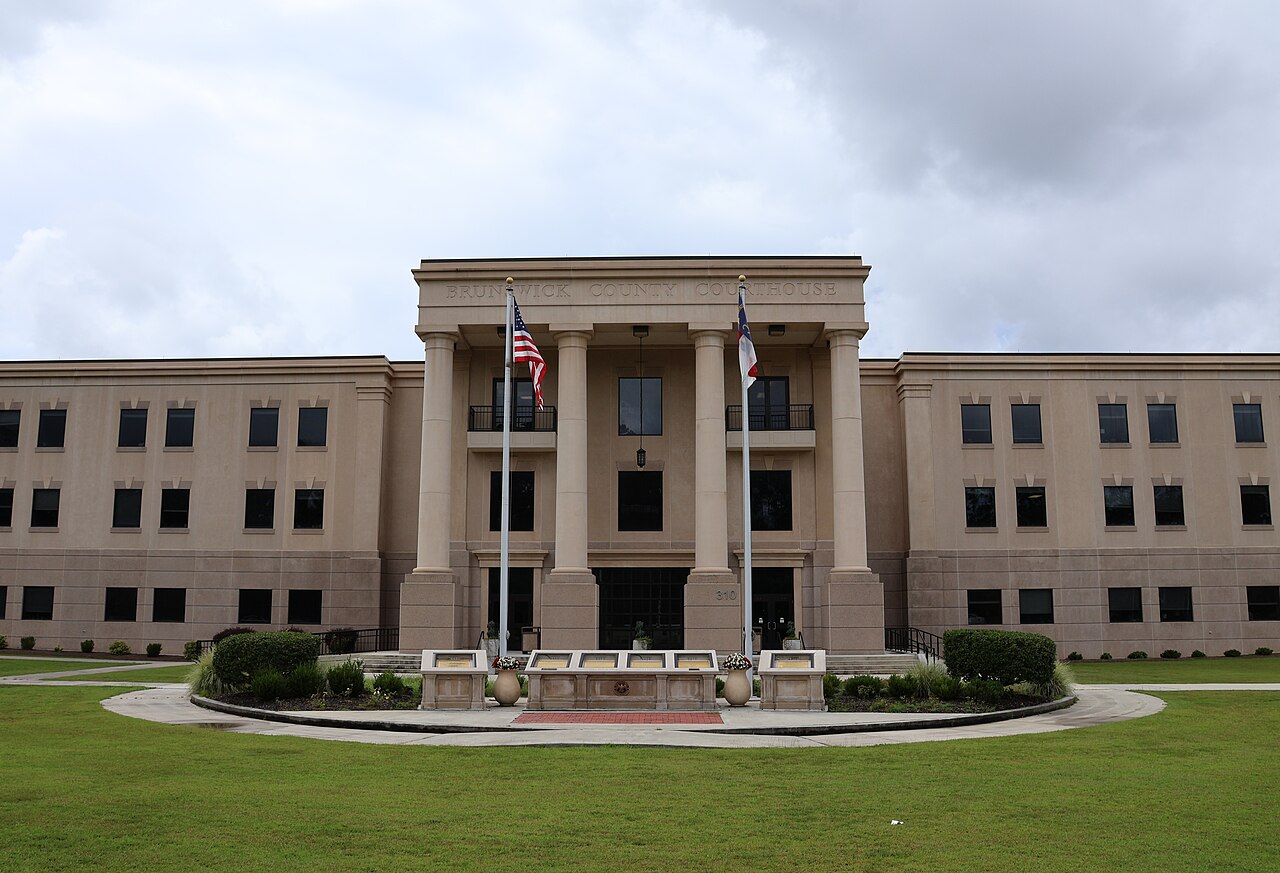
The lead image is the Brunswick County Courthouse at the county government center near Bolivia, North Carolina — a July 2023 photograph held at Wikimedia Commons (File: Brunswick County Courthouse (July 2023) 16.jpg; photographer DiscoA340; CC BY-SA 4.0). A place photograph: it claims the Superior Court setting of the six cases, and nothing more. Named in: Lead.